In the mornings before breakfast , on this tour, we have the option of having a meditation time together led by a young Canadian man who’s just finished studying at the University of Edinburgh and is going back to Canada to teach theology. It’s a wonderful way to start the day.
Straight after breakfast, our tour group walked to the nearby Garden Tomb. It’s outside the Old City walls. It has strong circumstantial evidence that it may be near where Jesus was crucified and then buried. The land was bought by Christians in the 1800s and it’s a beautifully quiet and tranquil garden, mainly run by volunteers. In stark contrast to where Jesus was crucified. Which was brutal, humiliating, extreme cruelty. But it does make a place where it’s much easier to think on all these things.

We were shown a nearby place that could have been where Jesus was crucified. And a tomb cut into the rock. Which even if it wasn’t Jesus’s tomb, shows what his tomb may have looked like. Much smaller than my imagination and picture books. But I can now understand why the women and the disciples had to stoop to look into the empty tomb.

As we sat in a quiet and shady corner of the Garden, Paul our tour guide read the crucifixion and resurrection story and we reflected and prayed for a while. It was very moving. Thinking over what happened in the Easter story. I’m a bit wobbly emotionally these days anyway because of events back home. So I got quite weepy. And that’s okay. Grief is a part of the story. A part of being human.

Then on to a bus to take us to the Mount of Olives. Back to where Philip and I were staying last week! So much happened there, not only in Easter week, but throughout Jesus’s ministry years. Nearby there are still some olive groves you can enter to help you visualise better all that happened there.
At the bottom of the Mount of Olives is a beautiful old Byzantine church with very old olive trees in the garden. They call it the Garden of Gethsemene. The old twisted and gnarled olive trees certainly look centuries old. But probably weren’t there when Jesus walked by because the Romans as they were destroying Jerusalem in AD70 also destroyed all the trees round about the city. But olive trees are very resourceful and often reshoot after being cut to the ground. So maybe their roots are old enough.

From there we walked through the Lion’s Gate back into the Old City of Jerusalem to the old church of the St Anne’s along the Via Delrosa way. Built in the Crusader days. Behind the church you unexpectedly find the ruins of very, VERY deep and huge Bethesda Pools. They were used for water storage. And there are stories of events that happened there both in the Old Testament and the New Testament.
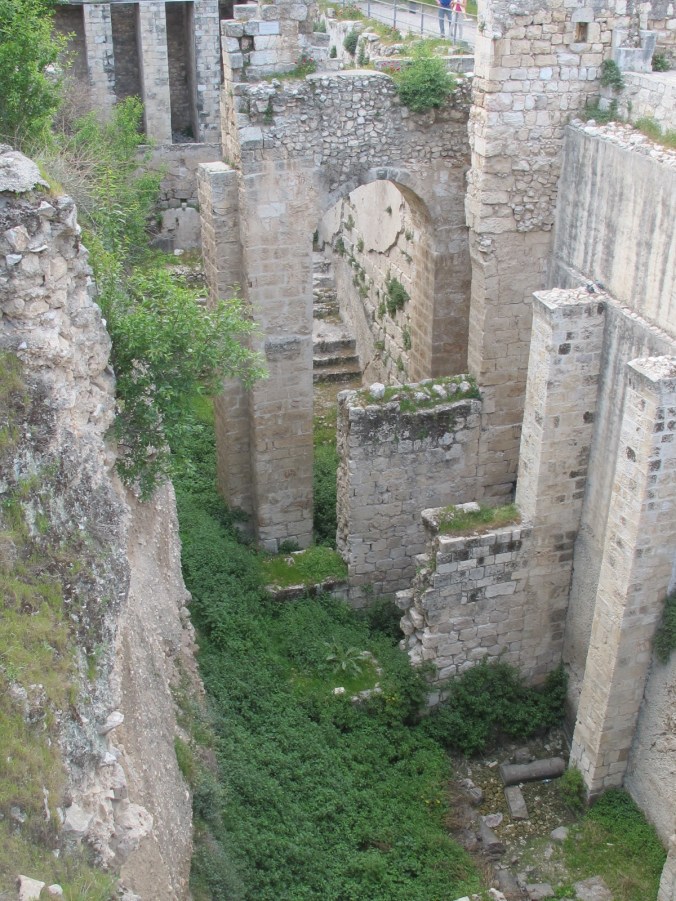
Whenever I have read the story of Jesus there I thought of them as maybe waist deep, or like a shallow swimming pool. But these are huge, deep water cisterns or water storage tanks for Jerusalem. About 13 metres deep. They are massive.
As a side note, until the 19th century, there was no evidence outside of John’s Gospel for the existence of Bethesda pool. So scholars argued that the gospel was written later, probably by someone without first-hand knowledge of the city of Jerusalem, and that the “pool” had only a metaphorical, rather than historical, significance. But in the 19th century, archaeologists discovered the remains of a pool fitting the description in John’s Gospel. With five colonnades, not the usual four colonnades. Bethesda Pool really was an historical place.
We went inside the beautiful St Anne’s church. And we were allowed to stand on the steps leading up to the altar and sing together “Amazing Grace”. The acoustics of this quiet, rather plain, but beautiful church are amazing. Every sound was clear but echoey as the song reverberated around its high cross-vaulted ceilings. That was a wonderful experience. We really are continually experiencing God’s amazing grace.
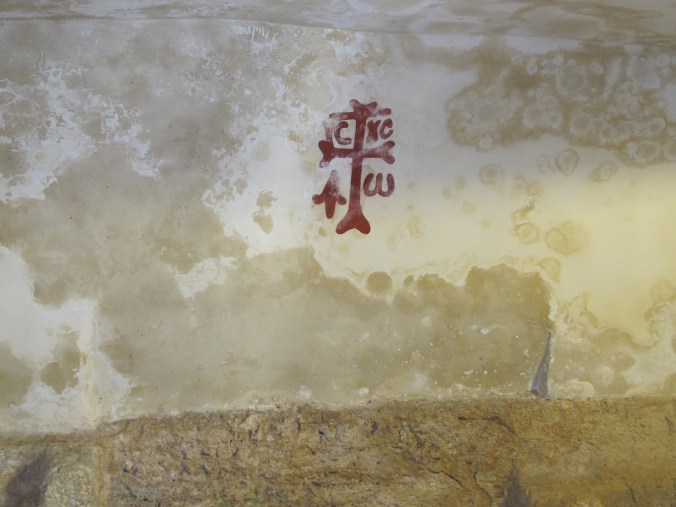
Then it was on to a monastery, still along the Via Delarosa. When we walked downstairs we could see underneath the monastery are old ruins and diggings. And a big area of paved huge flagstones. There’s the possibility that this could be the road that was there when Jesus was walking in Jerusalem. Or possibly not. They could be 100 years later. We stopped there again for another reading and meditation from the events of this last week of Jesus’s.
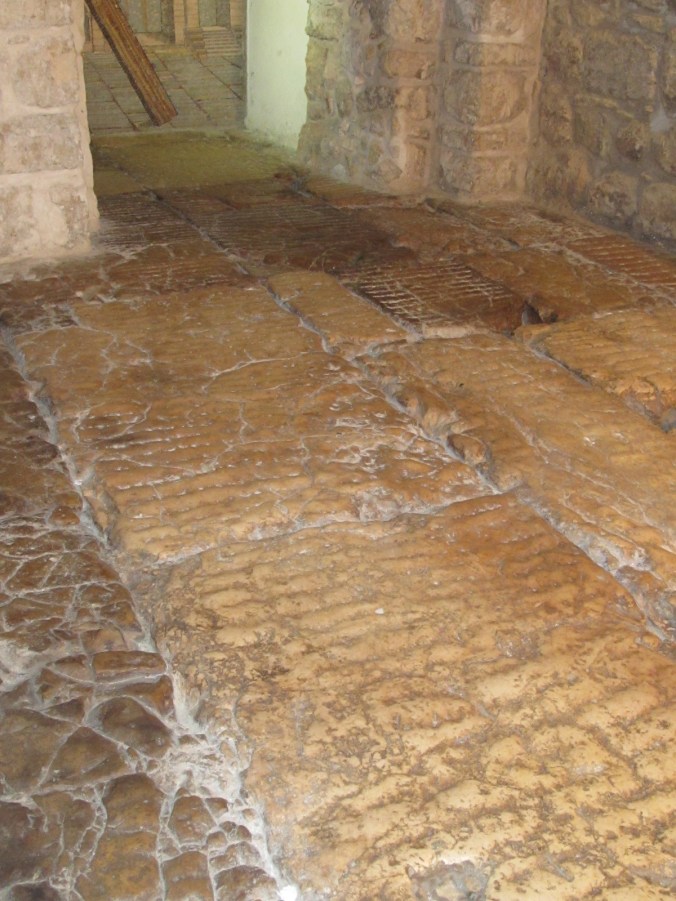
On one of the cobblestones is scratched the markings of a game of chance that Roman soldiers played at that time.

We had lunch at an Armenian cafe. That’s always a good time to sit next to somebody new and get to hear their story.
The next plan was to visit the Church of the Holy Sepulchre. The very narrow streets of the Old City which are normally crowded anyway at that time of the day suddenly became even more so! And they closer we got to the church the more crowded it became. We couldn’t get anywhere near it. Metal barriers were being erected part-way across some of the roads.
Paul and our Israeli guide Nerita decided to try to get there via another road. So we set off walking. It was hard to keep together. Many people have told me they were so glad Philip is on this tour. They just kept looking for his hat bobbing along ahead of them, so they knew which way to go and which corners to turn down. But in the end we abandoned the effort. Nerita who has been an Israeli guide for 20 years said she had never seen the streets so crowded. Even when the Pope came, there were orderly lines and queues. This was just pushing and shoving and crowding. Sometimes you couldn’t move at all.
It reminded me of that story of Jesus when he was being pressed by the crowds around him, and he turned round and said, “Who touched me?” And the disciples were amazed because everybody was being jostled around.
In the end we just headed for the nearest gate – Jaffa Gate – and flowed with the crowd. Although “flowing” is really too smooth a word. It was more of a jostling,barging, pushing and shoving than flowing.
Outside Jaffa Gate there was another huge crowd milling around two very slowly moving Scottish pipe bands. The whole works – tartan skirts, sporrans and sashes. Skirling bagpipes. The long baton being twirled vigorously and tossed high in the air. Huge drums being banged loudly. It was an Arab pipe band. Not sure of the significance of it. Maybe it was in honour of Easter. But I’m making that up. I asked Nerita, the Israeli tour guide and she said the pipe band was a legacy from the British Mandate days. I would never have guessed that there was such a thing as an Arab bagpipe band. Although there’s no reason why not! And there’s no photo of this. I couldn’t get anywhere near it. Even if I’d wanted to!
Tomorrow is an early start for a sunrise Easter service in the Garden Tomb.
 Standing on a hill
We are so enjoying your descriptions and personal observations and reflections ! Your posts are my breakfast reading to mum and I send them to Marilyn who is loving them also. Being in that jostling crowd would be my worse nightmare.
So good to hear from you! Love to you and your mum and Marilyn