In the darkening twilight last evening, Philip and I decided we’d like to visit the Old City in Jerusalem. Our hotel is on the Mount of Olives directly opposite it, but dividing it is a very steep valley – the valley of Kidron. And the slopes of the valley are covered all over with stone oblong boxes. It’s a Jewish cemetery and people have been buried here for over 3,000 years. Apparently, Jews still come from all over the world to die and be buried in this cemetery. Because that’s where they believe the Messiah will come and they’ll be resurrected and they’ll get a head start. We were also told that they now have to pay $US250,000 for this privilege. But the point to this whole story is that you can’t walk through the cemetery to get to the Old City. You have to go around it.
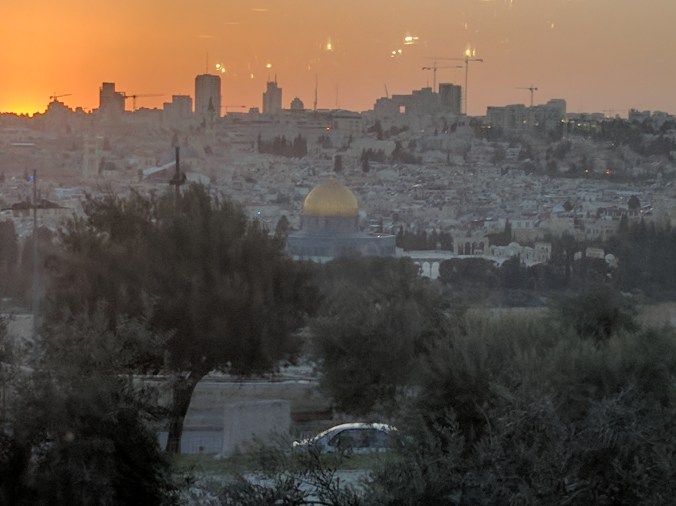
Eventually we found our way around it, down the narrow, steep, little road in the dark and up the other side to eventually find the entrance of the Lion Gate, set in the high stone walls and the entrance to the Muslim Quarter of Jerusalem. We wandered along narrow, cobbled streets with two or three-storied houses leaning over us. Lots of local people still walking about, and many children.
It is amazing to think that once Jesus – and lots of other people – once physically walked this way. I don’t mean that he actually walked on those cobbled stones. I think they’re long gone. But that he was once here. Somehow it makes Jesus seem more “earthed”, less ethereal to me. It’s hard to describe adequately. And I certainly didn’t expect that reaction in myself. I wasn’t expecting I’d have any reaction. I’m a very pragmatic person.
Today we headed south for Be’er Sheva (Beersheba). My Grandma Lithgow’s favourite brother was killed in World War 1 and is buried in the Commonwealth Cemetery there.
So we ordered a taxi from the reception of our hotel. A battered little car without taxi signs rolls up and says that he’s our taxi and for 75 shekels he’ll take us to the bus station. Not long down the road, he pulls over to a roadside bus stop and says we can catch the Beersheba bus here. No, Philip says, we need to go to the Jerusalem Central Bus Station. The young man repeated this twice more at roadside bus stops. He obviously didn’t know where to take us, and he rang a friend a couple of times to get directions. And eventually we got there. What I’m making up about this, is that it was really a son or nephew of the hotel receptionist who was our taxi driver!
It’s a huge bus station, several stories high. Public transport is used a lot in Israel. We weren’t able to catch the bus that we’d originally planned, but another came not long after. A big comfortable coach.
Heading south on four lane highways, we rolled through countryside that reminded us a lot of Western Australia. Lots of undulating land under crops in various stages from ploughed to newly planted to green and heavy and ready to harvest to harvested fields. Some olive and citrus orchards and big vineyards. Lots of eucalyptus trees and yellow-flowering wattle or acacias. The most interesting thing we noticed was that in many fields they had drip irrigation pipes (like in our home garden) only a foot or so apart in acres and acres of fields. Don’t know how they’d manage that system. We drove south for about an hour and a half.
I was expecting Beersheba to be dry and yellow and more desert-like. It’s in the Negev desert region. But it was green all the way there. But the distant hills south of the town were dry and yellow. Beersheba is a big town.
Our plan was to get a local bus that Mr Google said would take us there. All this gave me another glimpse of what it’s like to be a foreigner in a strange land, with everything around being unfamiliar, you can’t speak the language or read the writing and you can’t find anyone who can understand you. When we’d been on the local bus for a couple of stops, we asked when we should get out. And a lady who understood us said we were on the wrong bus. (Note to self: Talk to Mr Google about this anomaly!)
She was very helpful. We got off the bus and she did too. By this time we were fed up with busses and decided to get a taxi there. So she hailed a taxi for us and gave him directions. And we were soon there!
The War Cemetery is much smaller than I expected in a built-up area and beautifully maintained by the Commonwealth War Cemeteries. Roy Lang’s grave was easily found and we took photos. I laid on the ground some (by now, rather wilted) scarlet poppies that I’d picked and brought with me from the wasteland next to our Jerusalem hotel.

It’s all such a waste. Apparently he was a gentle, loving and lovely young man. Just 27 years old with a fiancee and family back in Queensland. Now all the people who knew him have gone, and he’s just a distant memory to remaining relatives.
I thought I’d put in some extra details from our family history that you can skip over if you’re not interested.
Roy was engaged at 26 to Elsie Ginn.
His sister Dora (who was my grandmother) wrote in March 1917 from Roy whilst he was in the middle east –
“The mail brought us two letters from Roy. One gave an account of his first real scrap. At 3 o’clock on the Monday afternoon they started off, and rode till nearly daylight the following morning. The Turks and Germans were entrenched near the shore and during the night our troops surrounded them completely. At daylight they started firing, and they fought all day and at sunset they surrendered. Then the Drivers, including Roy had to go forward and get some guns that had been captured and then he says he saw some sights he will never forget. The trenches were filled with dead and dying Turks, and a sprinkling of Germans. ‘I don’t care how soon the war ends’ he said. Poor Roy – he wouldn’t hurt a fly. He had saved the water in his water bag anticipating the long march and he gave it all to wounded and dying Turks.”
His sister Dora wrote again later –
“We had a letter from Alf Bidstrup, Roy’s special soldier friend, telling us all he thought we would like to know. It was outside Beersheba that our dear Roy received his call home. The timber wagons were all lined up ready for the attack when a Taube (a mono-plane) flew over dropping shells amongst the horses. Roy was wounded in the body and Bert in the thigh. They took him to the clearing station and although he felt no pain he ‘fell asleep’ the next day. The troops departed hastily from Beersheba but before they went they buried all their dead in the cemetery.”
By the way, at Beersheba the 800 Australian and New Zealand cavalry charged the entrenched Turkish position, about 4,400 strong. They charged across 5 kilometres of open country and 31 of them were killed and 70 horses died. And against all odds took the town. They were desperate to reach the water wells of Beersheba. The locals were very grateful.It was the last cavalry charge in history.
And now it’s all mostly forgotten.
We decided to walk back to the Beersheba bus station. And on the way back we came across a high circular wall with a huge sign saying “Abraham’s Well”. I wondered how touristy it would be, but we just pushed open a little door and found ourselves in an open space, completely encircled with the wall and a big mesh-covered well in the ground. How authentic is it? I have no idea. But I do know Abraham dug a well in Beersheba. And the local people for thousands of years have had strong oral histories, and water in this region is very precious so I guess it’s highly probable that it could be.

And once again, for whatever reason Abraham somehow suddenly seemed to become more alive and real as a person, not just a remote historical figure. There is real power in a physical place and presence. It seems more rooted and grounded somehow. I’ll have to think and ponder more about that aspect.
Another unexpected serendipity discovery!
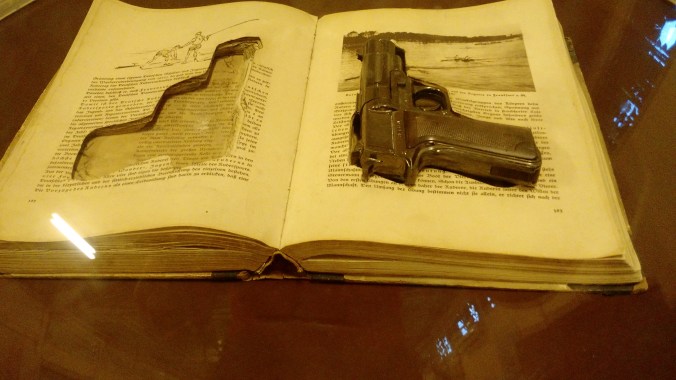 This is one of the ways the Israeli guerilla fighters smuggled weapons in, past the British who were in charge of the United Nations Palestinian Mandate.





 Standing on a hill