Amazing Grace Adventures.

In the mornings before breakfast , on this tour, we have the option of having a meditation time together led by a young Canadian man who’s just finished studying at the University of Edinburgh and is going back to Canada to teach theology. It’s a wonderful way to start the day.

Straight after breakfast, our tour group walked to the nearby Garden Tomb. It’s outside the Old City walls. It has strong circumstantial evidence that it may be near where Jesus was crucified and then buried. The land was bought by Christians in the 1800s and it’s a beautifully quiet and tranquil garden, mainly run by volunteers. In stark contrast to where Jesus was crucified. Which was brutal, humiliating, extreme cruelty. But it does make a place where it’s much easier to think on all these things.

IMG_1825

We were shown a nearby place that could have been where Jesus was crucified. And a tomb cut into the rock. Which even if it wasn’t Jesus’s tomb, shows what his tomb may have looked like. Much smaller than my imagination and picture books. But I can now understand why the women and the disciples had to stoop to look into the empty tomb.

IMG_1828

As we sat in a quiet and shady corner of the Garden, Paul our tour guide read the crucifixion and resurrection story and we reflected and prayed for a while. It was very moving. Thinking over what happened in the Easter story. I’m a bit wobbly emotionally these days anyway because of events back home. So I got quite weepy. And that’s okay. Grief is a part of the story. A part of being human.

IMG_1818

Then on to a bus to take us to the Mount of Olives. Back to where Philip and I were staying last week! So much happened there, not only in Easter week, but throughout Jesus’s ministry years. Nearby there are still some olive groves you can enter to help you visualise better all that happened there.

At the bottom of the Mount of Olives is a beautiful old Byzantine church with very old olive trees in the garden. They call it the Garden of Gethsemene. The old twisted and gnarled olive trees certainly look centuries old. But probably weren’t there when Jesus walked by because the Romans as they were destroying Jerusalem in AD70 also destroyed all the trees round about the city. But olive trees are very resourceful and often reshoot after being cut to the ground. So maybe their roots are old enough.

IMG_1835

From there we walked through the Lion’s Gate back into the Old City of Jerusalem to the old church of the St Anne’s along the Via Delrosa way. Built in the Crusader days. Behind the church you unexpectedly find the ruins of very, VERY deep and huge Bethesda Pools. They were used for water storage.  And there are stories of events that happened there both in the Old Testament and the New Testament.
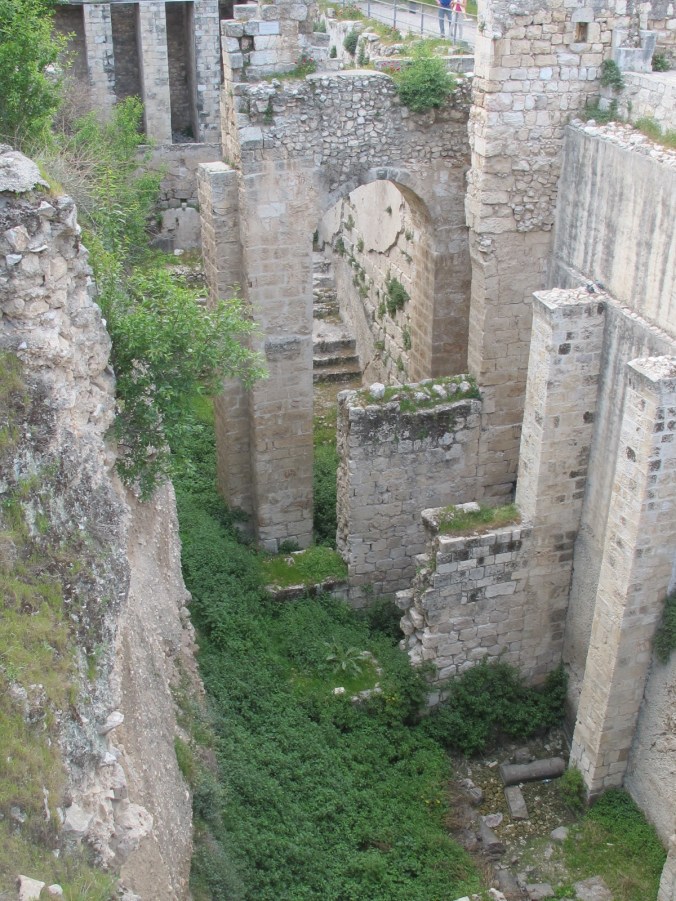
IMG_1836

Whenever I have read the story of Jesus there I thought of them as maybe waist deep, or like a shallow swimming pool. But these are huge, deep water cisterns or water storage tanks for Jerusalem. About 13 metres deep. They are massive.

As a side note, until the 19th century, there was no evidence outside of John’s Gospel for the existence of Bethesda pool. So scholars argued that the gospel was written later, probably by someone without first-hand knowledge of the city of Jerusalem, and that the “pool” had only a metaphorical, rather than historical, significance. But in the 19th century, archaeologists discovered the remains of a pool fitting the description in John’s Gospel. With five colonnades, not the usual four colonnades. Bethesda Pool really was an historical place.

We went inside the beautiful St Anne’s church. And we were allowed to stand on the steps leading up to the altar and sing together “Amazing Grace”. The acoustics of this quiet, rather plain, but beautiful church are amazing. Every sound was clear but echoey as the song reverberated around its high cross-vaulted ceilings. That was a wonderful experience. We really are continually experiencing God’s amazing grace.
IMG_1819

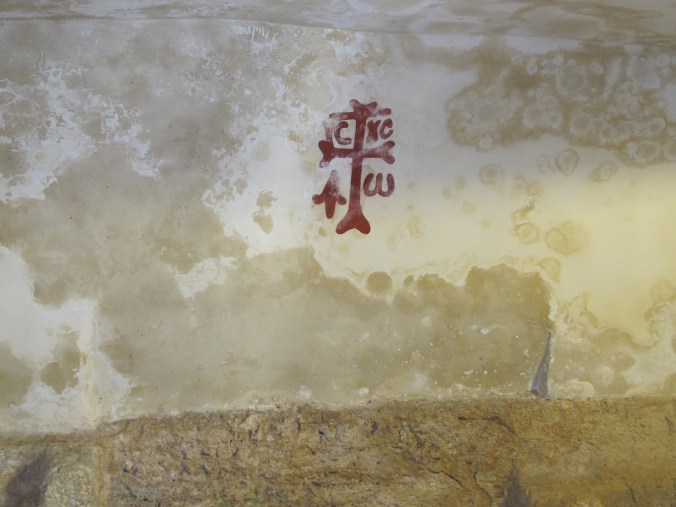
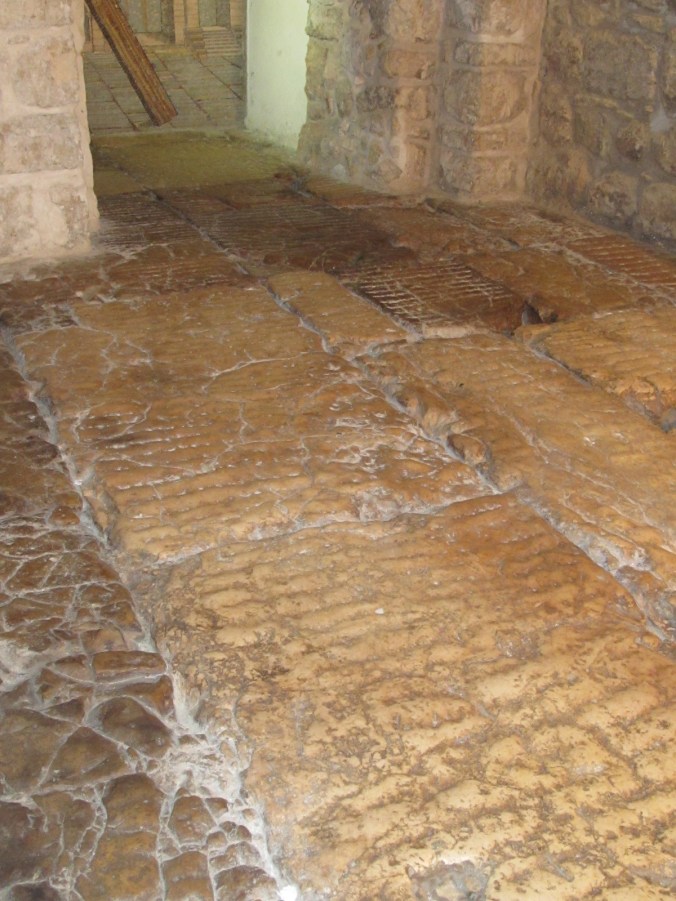
Then it was on to a monastery, still along the Via Delarosa. When we walked downstairs we could see underneath the monastery are old ruins and diggings. And a big area of paved huge flagstones. There’s the possibility that this could be the road that was there when Jesus was walking in Jerusalem. Or possibly not. They could be 100 years later. We stopped there again for another reading and meditation from the events of this last week of Jesus’s.
IMG_1845

On one of the cobblestones is scratched the markings of a game of chance that Roman soldiers played at that time.

IMG_1847

We had lunch at an Armenian cafe. That’s always a good time to sit next to somebody new and get to hear their story.

The next plan was to visit the Church of the Holy Sepulchre. The very narrow streets of the Old City which are normally crowded anyway at that time of the day suddenly became even more so!  And they closer we got to the church the more crowded it became. We couldn’t get anywhere near it. Metal barriers were being erected part-way across some of the roads.

Paul and our Israeli guide Nerita decided to try to get there via another road. So we set off walking. It was hard to keep together. Many people have told me they were so glad Philip is on this tour. They just kept looking for his hat bobbing along ahead of them, so they knew which way to go and which corners to turn down. But in the end we abandoned the effort. Nerita who has been an Israeli guide for 20 years said she had never seen the streets so crowded. Even when the Pope came, there were orderly lines and queues. This was just pushing and shoving and crowding. Sometimes you couldn’t move at all.

It reminded me of that story of Jesus when he was being pressed by the crowds around him, and he turned round and said, “Who touched me?” And the disciples were amazed because everybody was being jostled around.

In the end we just headed for the nearest gate – Jaffa Gate – and flowed with the crowd. Although “flowing” is really too smooth a word. It was more of a jostling,barging, pushing and shoving than flowing.

Outside Jaffa Gate there was another huge crowd milling around two very slowly moving Scottish pipe bands. The whole works – tartan skirts, sporrans and sashes. Skirling bagpipes. The long baton being twirled vigorously and tossed high in the air. Huge drums being banged loudly. It was an Arab pipe band. Not sure of the significance of it. Maybe it was in honour of Easter. But I’m making that up.  I asked Nerita, the Israeli tour guide and she said the pipe band was a legacy from the British Mandate days. I would never have guessed that there was such a thing as an Arab bagpipe band. Although there’s no reason why not! And there’s no photo of this. I couldn’t get anywhere near it. Even if I’d wanted to!

Tomorrow is an early start for a sunrise Easter service in the Garden Tomb.


A Good Friday.

First thing this morning, before breakfast we focused and meditated on the writings of Isaiah that foretold the suffering that Jesus would one day go through. Always a sobering and jolting passage that is difficult to dwell on. A hard reading.

Our tour bus drove us around the crowded hills of Bethlehem to the commercialised Manger Square. Bethlehem is Big Business. A big building on top of a hill in a commercial area that is actually three churches  – Armenian, Orthodox and Catholic. We got there early before “rush hour”.

IMG_1787

In the Armenian church there was scaffolding all through the interior for renovation and restoration. A service was taking place despite this. We tip-toed around to see what is purported to be the real manger and see the big silver star on the floor that is said to be the exact spot where Jesus was born.

IMG_1785

I actually found the whole experience to be rather jarring. And I’ve been analysing my response. It seemed to be more important to claim these spots than to be amazed at the wonderful absurdity of what was happening when Jesus was born in Bethlehem. That this was God and he had become a baby. It felt to me that the birth of Jesus was minimised. Minimised even more than it was commercialised.

The Catholic Church was quieter and it was much easier to sit in the pew and meditate and pray. Underneath the church are the caves of Jerome. In the 300s he sat in these underground caves in Bethlehem and translated much of the Bible into Latin and was a well known scholar of his times. I found that very interesting.

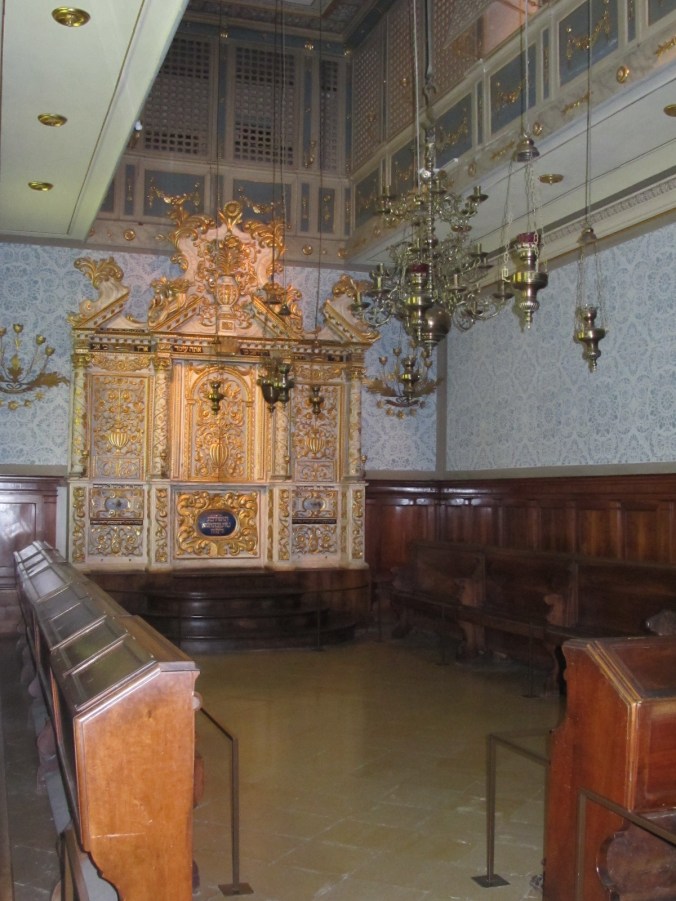
Then we were off on the bus to the Israel Museum. Philip and I had already spent several hours here on his birthday. I didn’t want to see the Dead See Scrolls again. So I took off on my own and looked through some exhibitions of Torahs (Jewish holy scriptures), and Jewish life. Including some disused synagogues that they’ve restored and reconstructed from South India, Surinam (South America), Venice and Germany. I’ve never been in a synagogue before.

IMG_1793

I was starting to run out of time so I had to rush through art galleries with wonderful Impressionist and Post-impressionist and other European paintings. Had to really skip through a major exhibition of Goya’s paintings and works. Which I was disappointed about. But you could spend months and months in this museum. So much to see.

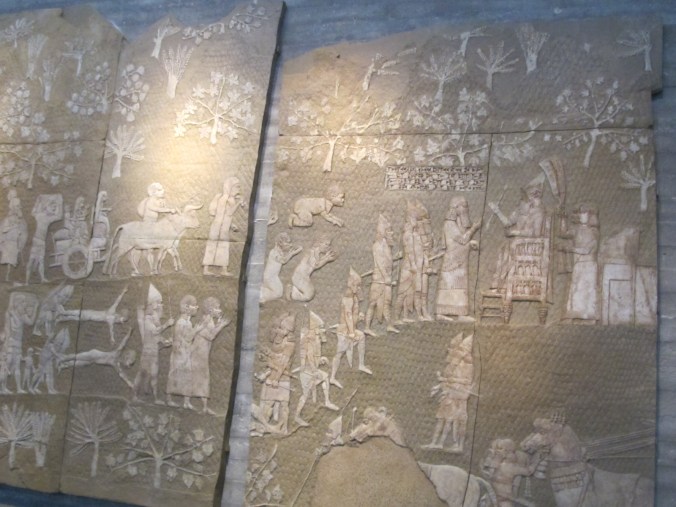
Then I rejoined the tour for our last bit. In the archaeological exhibitions. Paul who is our tour guide and comes many times a year with Oak Hall tours does a great job with enthusiasm in explaining stuff. He took us through the Canaanite exhibitions. The people and culture that was in the land when Joshua and the people of Israel arrived in the land. You can’t believe how interesting it was. Making it all so much more real.

IMG_1799

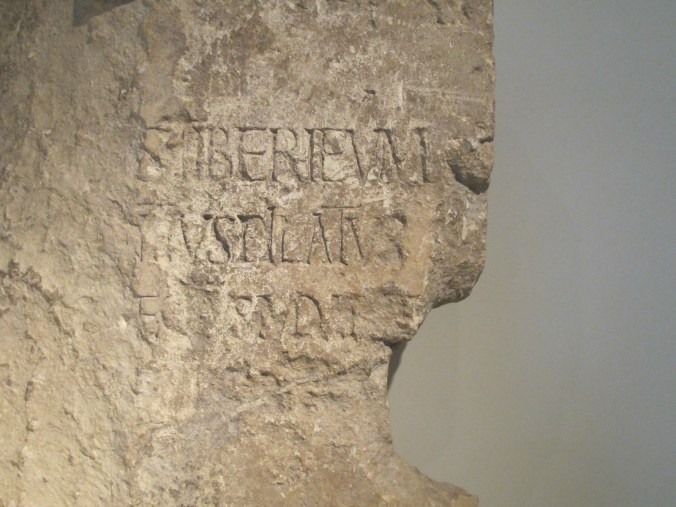
Paul especially pointed out the bits of archaeology that had echoes in the Bible. Inscriptions that mention people like David, Pilate or others mentioned there. A history and land of people who were once alive.

IMG_1801

I think this is inscription mentions Pilate.

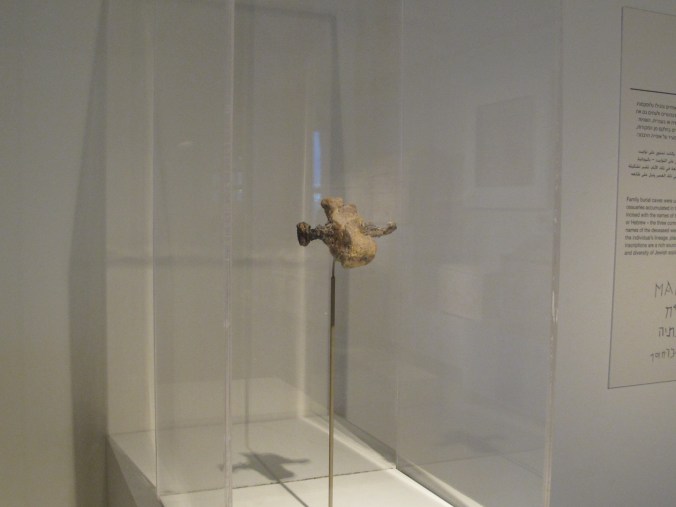
Then Paul showed us a small exhibit of an ankle bone with a huge bolt-like nail pierced through that has been found. From someone else who suffered a crucifixion. I found that viscerally jolting. Incredibly moving and deeply sad. I stood there for quite a while just thinking about it.

IMG_1800

So much of the exhibitions have vague echoes and memories from when I did Ancient History at school. But it’s so different to seeing it real. Not looking at pictures in a book or a documentary. But really seeing the physical objects.

We stopped for a falafalel or schwarma lunch. Just as we walked into the cafe a local boy walked by with a young sheep draped around his shoulders. We lots of little flocks of sheep and or goats in the fields around Bethlehem and outer Jerusalem today. Always with herders. A very Biblical looking scene. Except that the herders are usually talking on a mobile phone as they care for their flocks. The fields of Bethlehem are full of stones and boulders. Very rocky.

IMG_1802

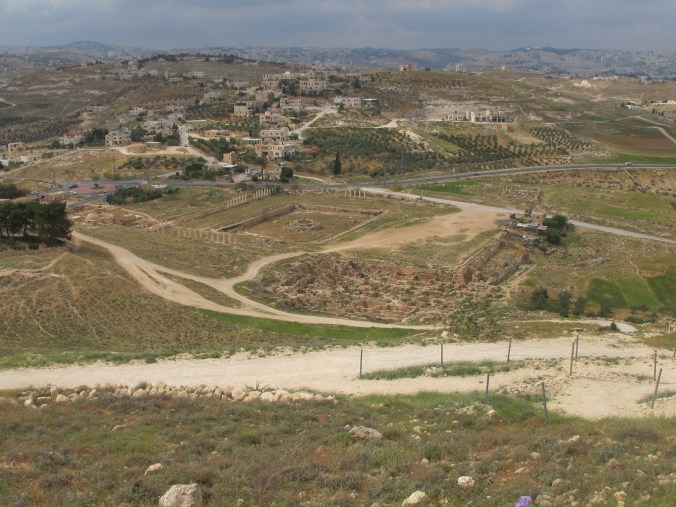
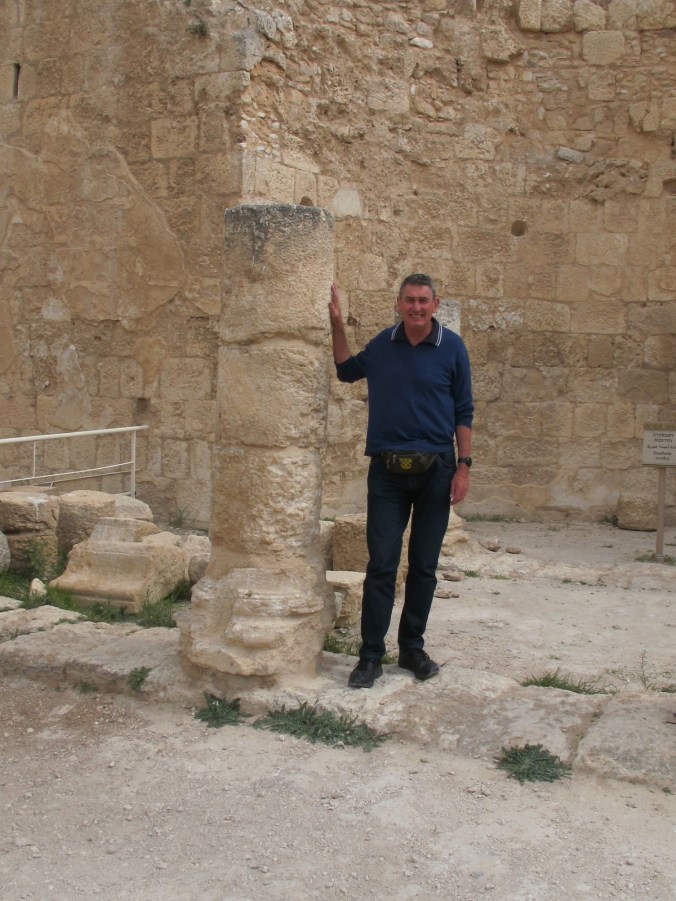
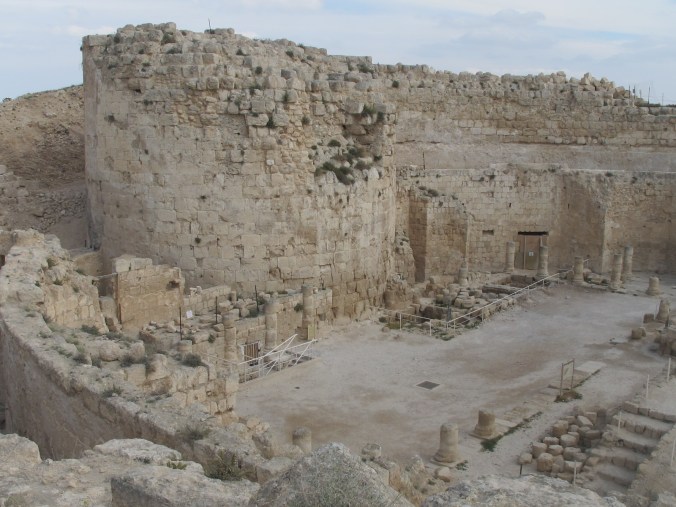
Then off again to The Herodian. The ruins of a palace and fortress built by Herod the Great on top of a big hill, overlooking all the surrounding countryside. Herod spared nothing in the way of expense when he was building his projects. Especially when it was for himself. We climbed through tunnels in the hill that had been used not only for water but also years after Herod by rebels against the Romans in their revolutions. A fascinating part of history that I knew little about.

IMG_1807

Herod went to enormous trouble to provide every luxury for himself in his lifetime. He was incredibly merciless and cruel to all those who crossed him or to any he thought may cross him. He built this fortress as a bunker if ever he did have a revolt. And he had an incredibly wealthy and complicated tomb also built for his death. He was so cruel that he ordered when he died that other dignatories should also be killed. So that there would be some grief exhibited. He knew everyone hated him. And yet, in the end, it all came to nothing. It’s all in ruins.

IMG_1813

We’re staying in Jerusalem at a lovely home-stay type hotel just a stone’s throw from Herod’s Gate of the Old City. The tour are the only guests here at the moment. We’ve met some really interesting people who do interesting things.

Tonight after dinner we had a short worship and meditation time, focusing again on the themes of Good Friday.

I’ll finish off with a completely irrelevant story. When we arrived at this hotel we were sitting in a lobby area. It’s mostly people from different parts of Great Britain on this tour. Staying in an Arab hotel. The TV was on in the lobby. It was muted but I recognised the actors. It’s a soapie from Australia. I don’t know the name of it. And it had Arabic subtitles.

Hope I can send this blog. The internet is a bit intermittent here. And it’s been a very Good Friday.


What’ll We Do?

We didn’t have anything planned for today. Apart from needing to be in Bethlehem in the late afternoon to meet up with the tour that we’re next booked on.

Philip wanted to again wander around the Old City in Jerusalem. But I wasn’t really enthused about that idea. I was all for doing something different. To look for or at something obscure. Within walking distance. And relatively cheap! So I bamboozled him with a dozen different ideas. I drive him crazy sometimes! And eventually we came up with a walk to the Monastery of the Cross.

About 40 minutes to walk there. In much the same direction when we went yesterday to the Israel Museum.

IMG_1778

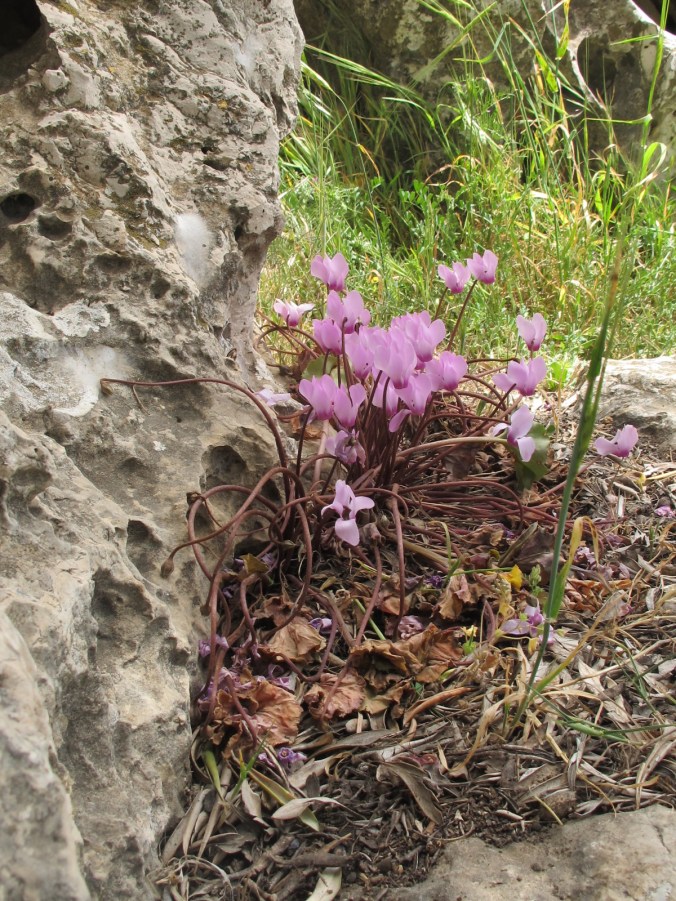
Israel is beautiful in the spring time. Wild cyclamen growing near rocks. Flowering trees and shrubs. Golden balls of wattle.

IMG_1775

The Monastery of the Cross is in a little green valley and has a long complicated history. Like all of this land. Going back to the 400s, the church has been demolished and rebuilt and fortified down through the centuries. For many centuries the Georgians (the people of the land between Russia and Turkey) owned it, but then the Greeks bought it and have had it ever since.

IMG_1773

It’s a huge building. But I don’t even know if it’s used as a monastery any more. There was one nun who was dusting the huge vaulted domed church room.

IMG_1772

Beautiful old Byzantine mosaic floor. Wonderful painted frescoes on the ceilings, domes and walls, depicting Biblical scenes. I found it fascinating trying to work out which Biblical story the pictures were portraying.

IMG_1759

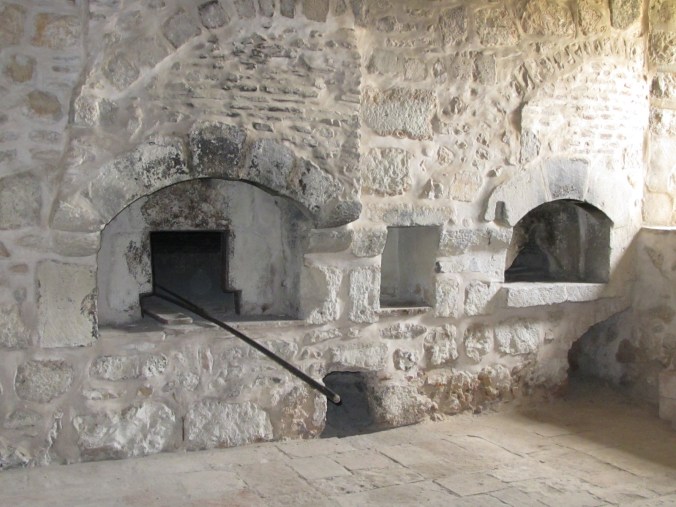
You can just wander about lots of the big old empty rooms. Some with artefacts from the past. Working objects like the kitchen and dining room with marble table tops.

IMG_1771

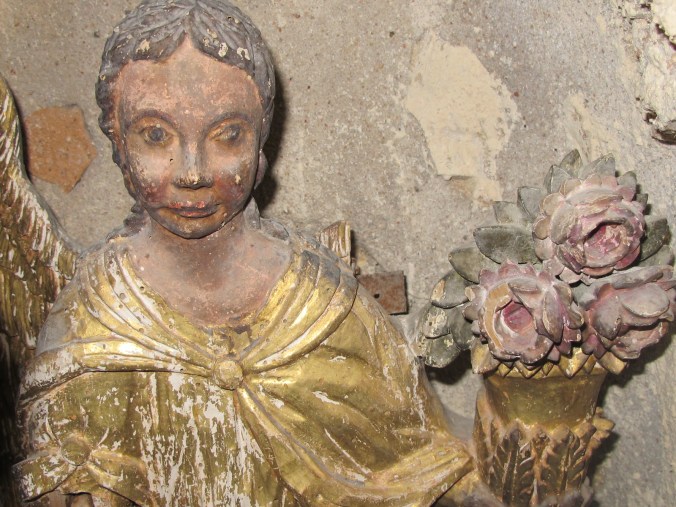
Beautifully wrought, carved and painted statues and icons just left propped up in empty rooms. It seems to be gradually crumbling away.

IMG_1762

The legend behind the Monastery is fascinating or interesting.  I’m not sure what other adjectives to use here. The shortened version says Abraham was given the staff from the Trinity when they visited him in his tent to tell him he would have a son. He planted the staff and watered it from the River Jordan where it grew into a three-pronged tree of pine, cedar and cypress. He gave a sprig of it to Lot who grew a tree. And from this tree the cross of Jesus was later made.

IMG_1758

One of the oddities in one of the side rooms was a framed picture of Sydney Harbour. Taken long before there was a big settlement there. Where did that come from and why was that there?

IMG_1761

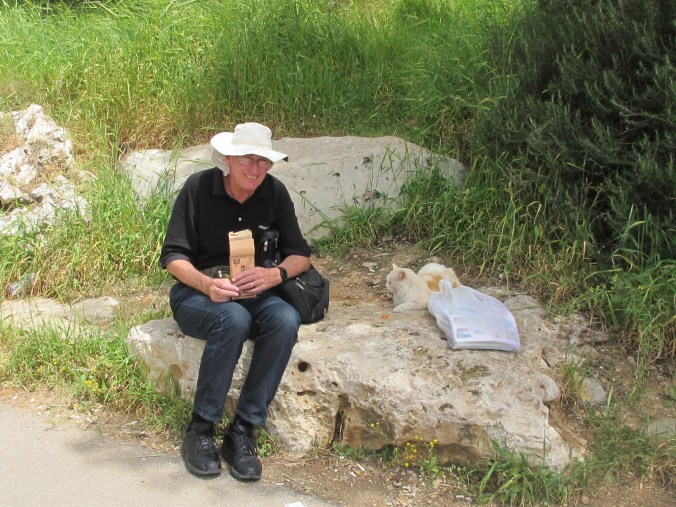
We had our picnic lunch sitting on a rock outside the monastery. And guess who joined us? A cat of course!

IMG_1774

Then it was time to go go Bethlehem. Which is really now just a suburb of sprawling Jerusalem. Or rather, they’re both sprawling towards each other. But Bethlehem is in the Palestine section so you can’t use Israeli taxi drivers. They’re not allowed by law to go there. So we rang the taxi driver we’ve used before. His mother was Israeli and his father was Palestinian. So he’s allowed to go there. But he can’t stay there, even though he was born in Bethlehem. He isn’t even allowed to pick up a paying customer from Bethlehem to take back to Jerusalem. He is such an interesting man to talk to. To hear different perspectives on life in Israel these days.

But it ended up taking us one and half hours to drive to Bethlehem. And it’s only a few miles away. I have never been in such traffic jams. Not even in Beirut or Los Angeles. It’s because of Pescha (Passover), the taxi driver said. Just standing still in traffic for long periods of time. Horns tooting. Cars trying to push in and past you. He tried three different ways to get to Bethlehem and eventually we came in round the back way. It took us nearly twice as long as getting to Tel Aviv which is the other end of the country. And costing us more than a trip to Tel Aviv.

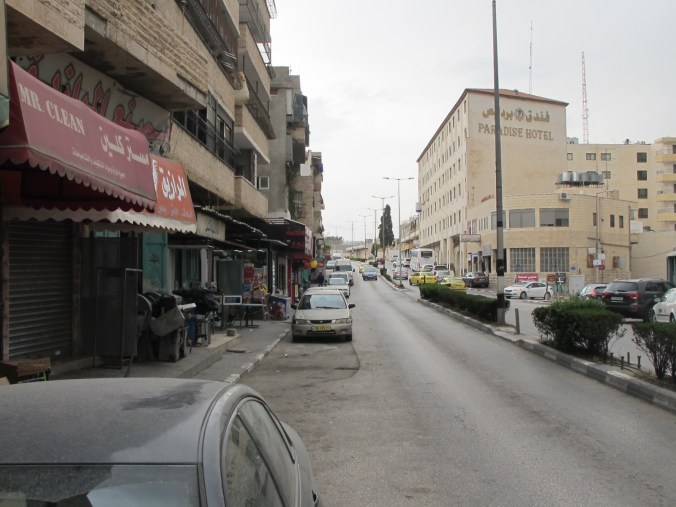
We were glad to get finally get there. Bethlehem looks nothing like what you’d imagine. Even when you’ve made mental allowances. It’s a very big town. And very bedraggled and tired. Our hotel is called Paradise Hotel and is very nice! Much higher standard than what Philip and I usually book!

IMG_1782

We were meeting our tour at dinner time. So in the meantime we went for a short walk. Bought some bananas as we were hungry. And some souvenirs for grandchildren. We got talking to the Arab shopkeeper. He finds it very hard that he is never allowed to ever go to Jerusalem. Most of the Arabs in Bethlehem are Christians but none of them can go.

And now we’ve joined up with our tour group and had dinner together with them. A wonderful Arab buffet dinner at the hotel. There’s nearly fifty of us in the group, so it’s bigger than I expected. And they’re a bit older than I expected. A lot of them are our age!

I thought I’d finish this blog with a photo from the kitchen of the Monastery. It was such a fascinating place. I’m still mulling over the thoughts such a place engendered in me today.

IMG_1768


Happy Birthday Philip!

A leisurely start to start celebrating Philip’s birthday today. We had breakfast on the rooftop terrace of our hotel. I made a picnic lunch with some of the extra breakfast. Gave Philip some chocolate that I’d brought from Perth as his present. Any other present would be superfluous, with us being on such a special trip here.

I organised the day to be dedicated to doing “Philip-fun” things. So with the help of a new (to us) app called HereWeGo we walked to the Israel Museum. (An Indonesian/Dutch couple we befriended on Mount of Olives told us about HereWeGo.) We’re now staying on the west side of Jerusalem, but still not far from the Old City. So we’re now in a Jewish section. I enjoyed wandering through the Jewish streets, looking at their housing and gardens. It’s only a 40 minute walk. We’re surprised by just how hilly Jerusalem is. No matter where you are. You seem to be always going either up or down. Hardly any level walking.

And how many cats live in Jerusalem? I’m making up that there’s twice as many cats as people. No matter where you go or what the time of day, you will see lots of cats. Lots and lots. Not mangy, feral looking cats. But contented well-fed tabbies sunning themselves or stalking the streets. They’re everywhere.

The Israel Museum is near the Hebrew University and incorporates many art galleries as well as many historical and archaeological exhibitions. Huge open spaces and galleries. Wide open gardens and different levels everywhere.

The jewel in their crown are the Dead Sea Scrolls. Which was our primary focus. We spent a long time there. It really was amazing. A lot on the discovery of the Scrolls and the community that lived there and preserved them. The Dead Sea Scrolls are an amazing, inspiring story and find.

I know this is a difficult to decipher photo. But it’s Philip looking at some of the exhibit. You weren’t supposed to take photos. So I snuck a photo without flash – and the result shows! But it was such a thrill for us to be there.

IMG_20170412_171222289

There’s also a huge Jerusalem model outdoors of how Jerusalem probably looked at the time of Jesus. After looking at it, I understood more of the Jerusalem Archaeology Park we’d seen earlier in the park. I still find it incredible to discover that we’ve walked in places that were in place when Jesus was there in Jerusalem.

IMG_20170412_173242593

Other amazing exhibits we saw at the museum – Jewish life in different countries down through the centuries, mummified Egyptian, wonderfully decorated manuscript Old Testaments, lots of archaeological artefacts from pre-history in the Middle East.

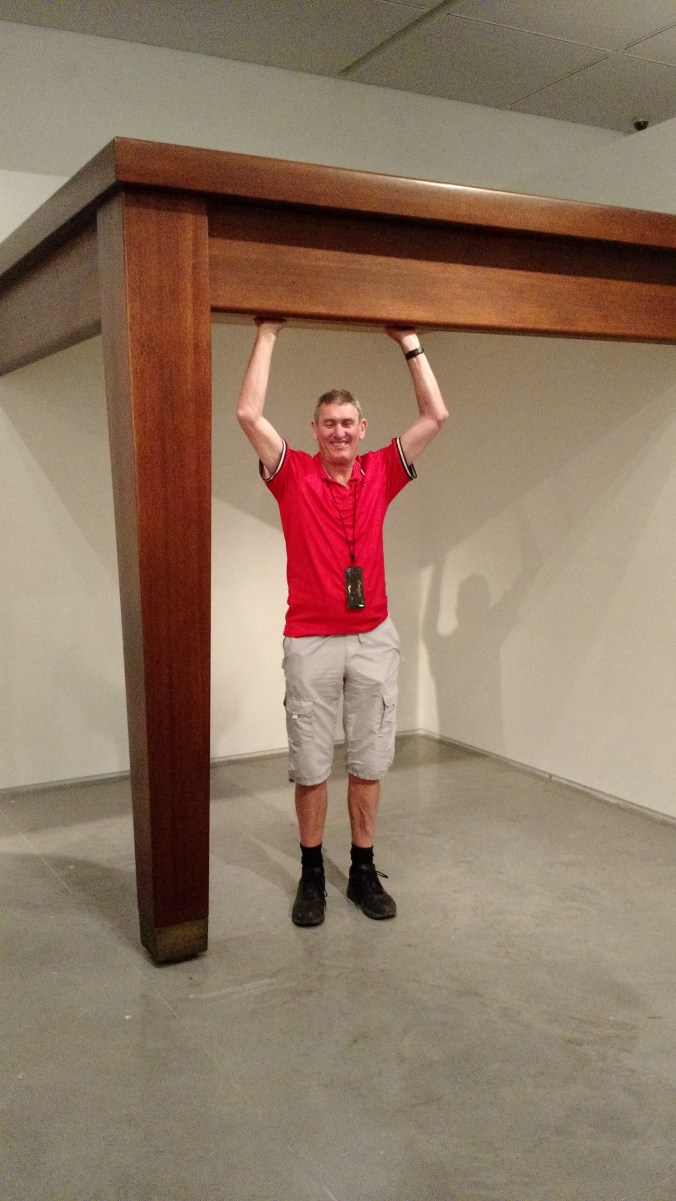
Lots of art galleries that would have been fun to explore but by this stage we were weary, hungry and at “saturation point”. So just one art gallery. Here’s Philip in an Alice in Wonderland moment, under a table.

IMG_20170412_191432343

A very late picnic lunch outside the museum.

IMG_20170412_192705884_HDR

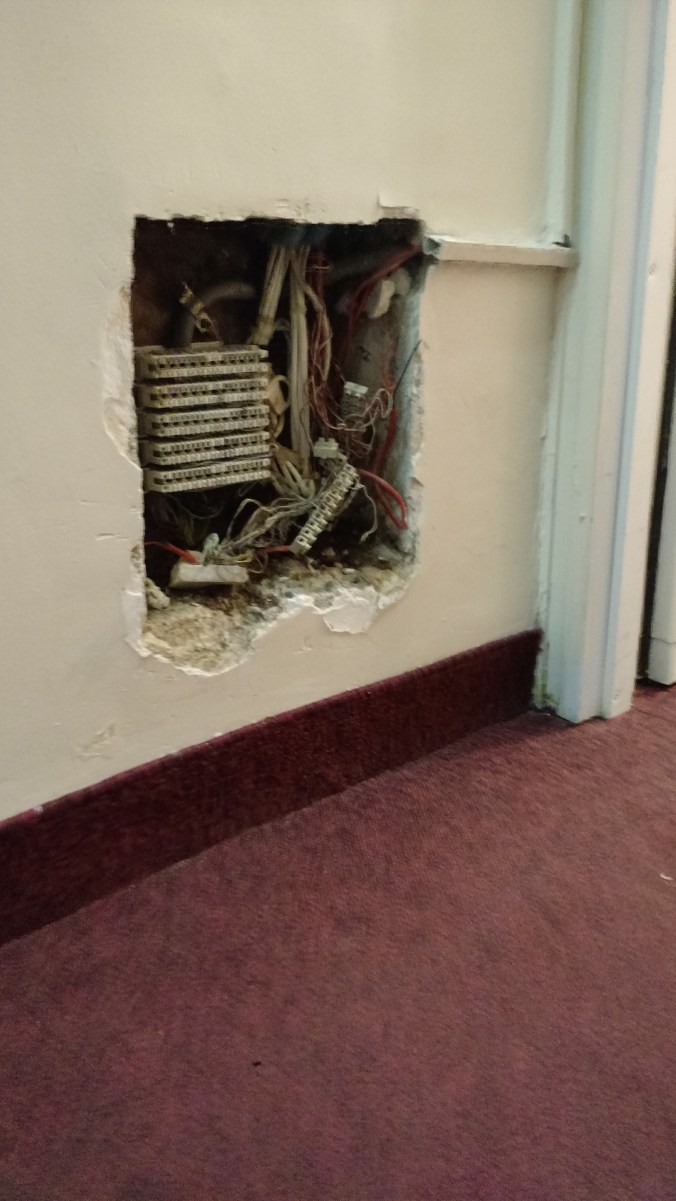
Then a walk back to our next hotel. This hotel is more like a backpackers, but adequate for us and quite comfortable. I took this photo of their electrics. It’s outside our door in the passage way. A hole cut in the wall.

IMG_20170413_014456245

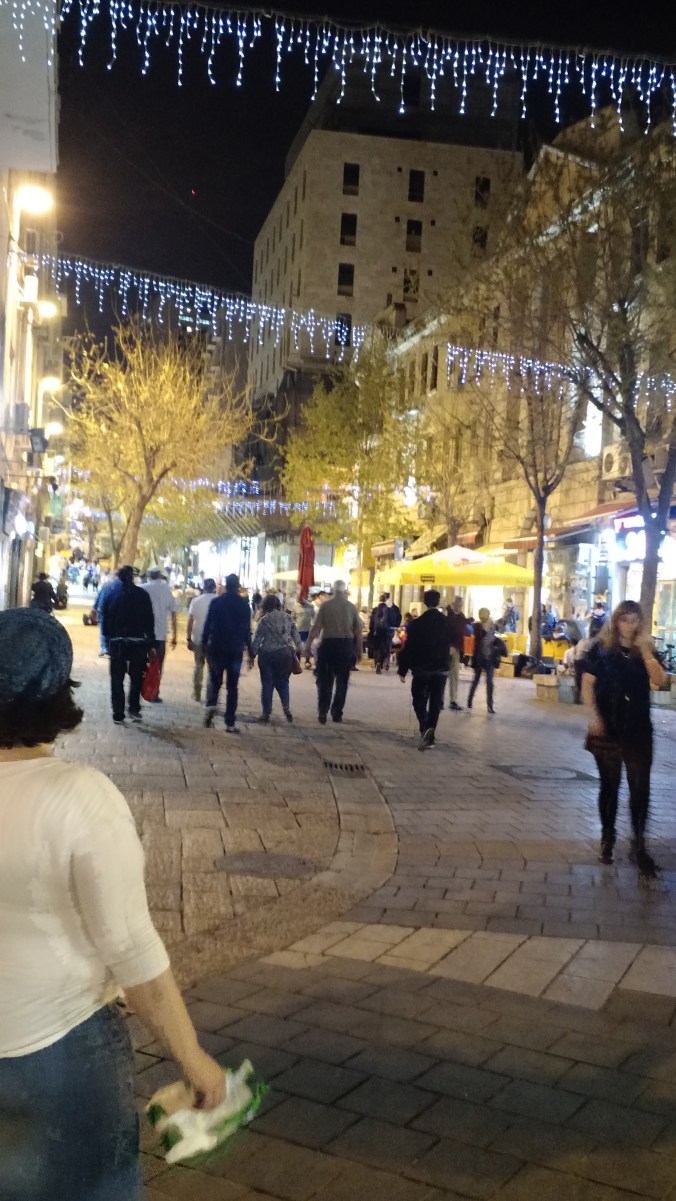
We went out for a celebration birthday dinner this evening. Wandered around Jewish shops and malls. A few of them closed because it’s Passover holidays.

IMG_20170413_245212598

We thought we’d like to try something different. We wandered down some little alley ways and found a Georgian cafe called Kangaroo. Georgia as in the country that is between Russia and Turkey – near Armenia. Not sure why their cafe is called kangaroo! Philip had a deep-fried meat pastie! A bit salty, he said, but good.

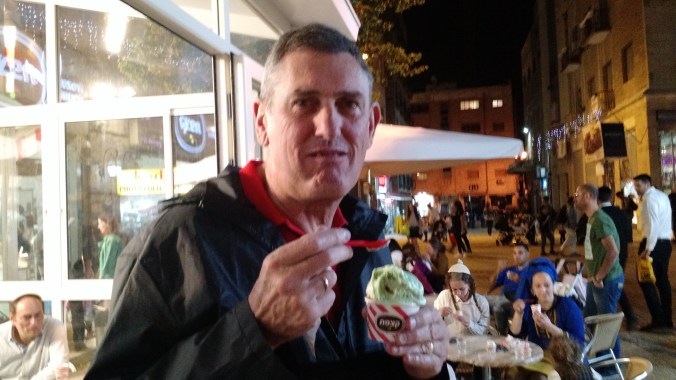
Then he finished it off with a special birthday treat of Jewish ice-cream! Happy birthday Philip! A birthday to remember! I’m very blessed to have spent it – and our married lives – together! Thank you!

IMG_20170413_010208859_TOP


The Desert Experience.

We slept so well last night here at Wadi Rum. Under a canvas tent in the desert. I woke  early to the Muslim call to prayer, roosters and barking dogs from a nearby small Bedouin settlement and a train chugging along. Sounds float a long way through the desert air. Trains in Jordan aren’t for passengers but for carrying phosphate which is mined and is Jordan’s main export.

Jordan has a population of 6 million and a refugee population of 4 million. From nearby Syria and Iraq. Australia does not have a refugee problem at all. I’m thinking that Jordan has a bigger issue than we do!

Wadi means valley. And Rum means mountains. This area is full of both.  Wadi Rum. It’s probably very similar country to where Moses and the people of Israel travelled through and lived in for so long.  The Edom mountains are nearby. Being here makes the Moses and Israelite story very real and powerful.

I’m not sure why when I think of the phrase “desert experience” my default thoughts are negative. Both physically and metaphorically. Dry. Dessicated. Lonely. Barren. Desert experiences are often like that. But not always. The desert is also a powerfully positive time. Remember Moses and the burning bush. Jesus’s experiences in the desert. It can be strangely strangely beautiful. Strengthening. Awakening.

I went for a walk before breakfast. Up to the top of a nearby shale covered hill and down the other side. When I was at the top I looked down to the other side and saw down below two camels, with a man riding one of them. It was so quiet I could hear the padding sound of the camel’s feet as they touched the sand.

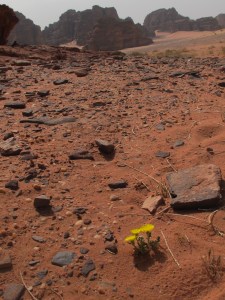
It’s spring here. And in crevices and cracks I discovered pretty little desert wildflowers.

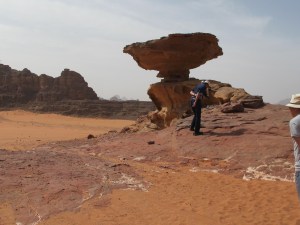
After breakfast in the open dining area, Philip and I and a Korean man went for a ride in the desert on the back of a 4 wheel drive ute. This area has been used for lots of movies – Lawrence of Arabia, Star Wars, The Martian. Our driver would stop every now and then. We climbed to the top of a yellow shifting sand dune. The driver said the wind constantly moves the sand dunes. This desert seems more barren than the Nullarbor or Arizona deserts that I’ve seen.

The mountains are high and sculptured from centuries of weather – the rain and the wind. We stopped at several places. At one place we were invited to give a yell. Philip did his coo-ee call and it echoed over and over as the coo-ee bounced around the mountain walls.

We went into a small cave at the bottom of one mountain that had once been used as a storage cave for spices, salt and other goods. Philip couldn’t go in very far as the roof was too low.

Sometimes we would just sit still in the shade of some rocks.  The desert was completely silent except for the sighing of the wind. No other sounds. Just a few busy ants or beetles scurrying around. And in the far distance you would often see camels. It was a meditative and reflective calming silence to sit in. Very easy to pray there.

The Korean man didn’t have a lot of English. And we had no Korean. But he expressed how much he enjoyed the space and the silence. He said in Korea it is just so crowded with so many people and it is so hard to find silence.

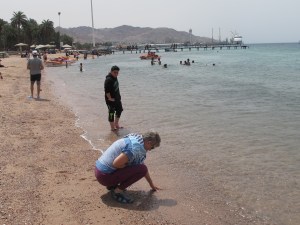
Then time to pack up and head off again. We were driven to the town of Aqaba, the Jordanian city on the Red Sea. From here you can see Egypt and Syria. And Saudi Arabia is not far away either. We walked down to the Red Sea where there’s some tourist beaches. In Australia we are so spoiled for beaches, that it didn’t impress us. But there were some people splashing around very happily. Even very big boys had swimming rings on as they swam. But I splashed my hands in the Red Sea to say that I had!

Had a great lunch at a fish cafe there and then it was off again to the Jordan/Israeli border. Lots of paperwork and lines again, and walking down the no-man’s land strip 200 metres long with high wire fences on either side of you.

But our booked driver on the Israeli side never turned up. The office we booked it through weren’t answering their phone. After waiting a long time in the hot sun we got a taxi to the nearby town of Eilat to their little airport. We were supposed to have a tour of this little town which is the Israeli beach town on the Red Sea. But as he never turned up, we haven’t had it. A pain really because it was prepaid. But if that’s the worse that happens this holiday we’ll be all right!

I went for a walk and found a museum. But it was closed. We’re making up that’s because of the Passover holiday. Passover is today. We’re sitting in a McDonalds in a nearby shopping mall. Half the shops are shut. But McDonalds isn’t. It means I can get a blog written to you before we walk back to the airport. There’s a nearby beach on the Red Sea. It’s very busy with people.

We’re flying back to Jerusalem tonight. My personal – and very limited – perspective is that outside of Jerusalem there doesn’t seem a lot of interest in practising the Jewish religion. That’s also from talking to people too.  It’s probably like Australia and the celebration of Christmas and Easter. But I’m making all of this up!

Yalla, yalla!

That’s probably not be spelt correctly. But I heard it a lot today. My interpretation is that it means “Come along now” with slight undertones of “hurry” too.

A 3.30 am start this morning. For a taxi ride through quiet Israeli streets to the small airport north of Tel Aviv. To be dropped at the gates to wait for the airport to open at 5.30am. A very, very thorough security and baggage check. Is it normally like this, or have they stepped it up because of what happened in Egypt on Palm Sunday?

Then a 30 minute flight on a small plane south to Eilat, a town on the Red Sea. But we were hardly up in the air and then we were coming down again. A bit like getting a plane from Perth to Dunsborough.

To be met by others on the tour and the tour rep who was very good at expediating the border crossing into Jordan. More paperwork, more money, more security checks, more bag checks.

What tickles my funny bone is that Israel isn’t recognised by many Middle Eastern countries. So for them all to co-exist and make it work – especially in the tourist industry – Israel doesn’t stamp your passport. Your visa, your entry permit and your exit permit are all on little slips of paper so there is no record that you’ve been to Israel in your passport. Then when you go to places like Jordan you take those little slips of paper and put them in your pocket and they happily stamp your passport with their Jordan stamps because you haven’t really been in Israel! Except that you’ve just walked over the border, down the road between high wire fences out of Israel and there is nowhere else you could have come from!

It’s a bit like buildings without a thirteenth floor. You can call them 12A or fourteen. But no matter what you call it, it’s still the thirteenth floor.

Then off we went in a coach on a four lane highway for about 1 and half hours through the desert to Petra. The overwhelming colour is brown. High, jagged, steep and very very stoney mountains everywhere. The mountains of Edom. Philip said it reminded him a lot of the Pilbara region of W.A.

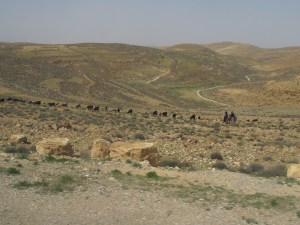
And every now and then you’d see a black Bedouin tent in the middle of the stones. Small flocks of sheep and goats always watched by someone. Often they’re just sitting there. Occasionally walking around with a staff. It looks such a Biblical scene. And I wondered why did Jesus call himself a good Shepherd, and not a good Goat-herder? And why are we his sheep and not his goats?

Sometimes there’d be a faint green fuzz on the stoney ground and mountainsides. The Bedouin plough these stoney grounds and plant wheat and barley – not to be harvested – but as feed for their animals.

As we got closer to Petra, the mountains became not quite as jagged, a bit more rounded. Petra is big tourism business. It’s a town of 25,000 people. A lot of the Bedouins are starting to settle into houses now. There’s a huge bus park and entrance and people milling around everywhere.

It’s an hour downward sloping walk through high gorge walls on either side of you. As high as Katherine Gorge walls. And even though everyone has seen the photos of Petra’s most famous building, called the Treasury, it’s still a “wow” moment when you first glimpse it through the narrow chasm.

Petra was a huge trading city and area for centuries and the Naboteans were a powerful trading civilisation till the trading routes changed. And all those carvings and buildings, including the Treasury are really mausoleums. The Nabotean buildings and towns were destroyed by a couple of earthquakes centuries ago. The mausoleums got looted centuries ago and then the empty holes and caves did become dwellings for the indigenous people of the area for a long time.

There’s a huge amphitheatre that seated 6000 people, carved into the stone.

That huge “Treasury” building is amazing! When we first glimpsed it, the tour guide played the Indiana Jones theme music softly on his phone! To help the atmosphere I think!  But it’s very impressive. “They” estimated that it took 100 men working every day for 20 years to carve it. It is massive. They did the carvings from the top down, using scaffolding and ropes. How important it seemed to be remembered and revered after their death.

We spent about 4 hours there. There are horses, donkeys, camels and horse-drawn carts careering up and down the roadway. Lots of hawkers trying to sell you tourist stuff.

Parts of the roadway still have the original boulder cobblestones. There’s drainage channels carved into the sides of the road. A very clever and competent civilisation. And now it’s all gone. With not a whole lot to remember it by.

After a late lunch in a cafe back into the town of Petra, it was back on the bus again. But before we got back to Eilat, Philip and I got off that bus and we’ve made a tourist detour.

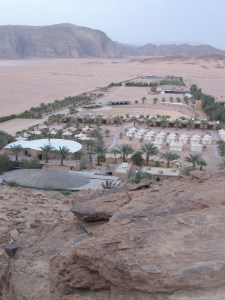
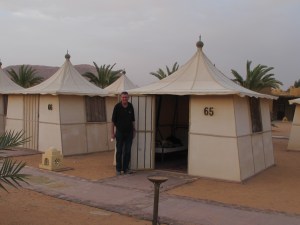
To Wadi Rum. A Bedouin tourist camp. Driven here far off the highway by a Bedouin in a four-wheel ute. It’s a big stoned wall enclosure with lots of date palms and little tents set up. Philip and I have got a little tent with two very small beds in it. But there’s sewerage toilets and running water. A big open area where we’ve just had a buffet Jordanian dinner. About 30 or so tourists here.

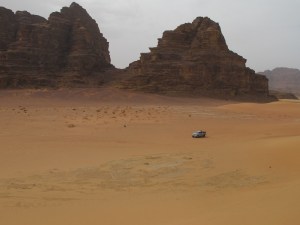
Wadi Rum, taken from the top of a big hill we climbed

But I was very surprised to get the internet here. Let’s see if it’s strong enough to send a blog. I laughed when we got here and asked “Did the Bedouins have electricity in their tents?” But then I discovered there’s wifi in the eating area! Amazing!

And soon we’ll be ready for bed. We’re both quite weary after such a long and fun day. So I don’t think it will matter what our mattresses are like. And I’m trying to remember the last time I had to take a trek to go to the toilet in the middle of the night!

I got it wrong!

Just after I sent off the last blog, Philip and I went for an afternoon walk. Our plan being to walk the road along the top of the Mount of Olives through the Muslim village there. (Our hotel is at the end of the road along the top of the Mount of Olives.)

We soon came across a long stream of people waving palm branches and singing exuberantly. The Palm Sunday procession. That I thought was being walked along the Via Delarosa which is a narrow road inside the Old City.

I got it all wrong. Don’t believe any of the facts that I ever tell you in this blog by the way! Even my opinions and thoughts are highly suspect and liable to change!

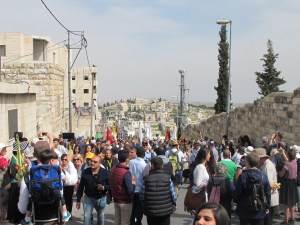
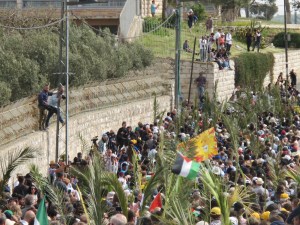
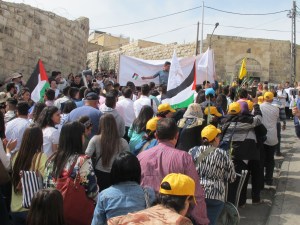
The Palm Sunday procession has thousands of people in it. Not hundreds. Thousands. Maybe ten thousand. And they walk from the Mount of Olives down to the Old City and right around the old city, passing by all the gates. They will finish at 8 o’clock tonight. Walking for about 7 hours. The roads round the Old City are all cordoned off.

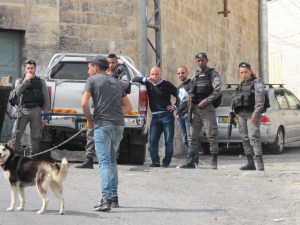
First up were several Israeli army with machine guns drawn and pointing forward, constantly glancing round. I did find that a bit unsettling. Even momentarily frightening.

Then the crowds of people. Mostly in organised groups. Waving palm and olive branches. Singing their songs of faith in their language. From so many different branches of the Christian faith. A lot of Palestinian flags were also waving, as well as their national country’s flags. Some of them exuberantly dancing, clapping and singing. Hope they’re still as exuberant at the end of their procession. I’m sure they’ll be hoarse.

At the very end of the procession was a group of high end clerics. I’m making up that they’re probably Archbishops or something like that. And to close it all off, more police and Israeli army with guns.

And I’d said that Philip and I weren’t going to do the procession. We had to in the end. To move from our position on the top of the hill. It was fun to do. But we didn’t know the songs they were singing. We were mainly with a Filipino Catholic group and they were singing in Tagalog.

Just as I said. Life is an Adventure. And you never know what’s going to happen next! Like walking in a Palm Sunday parade in Jerusalem.


Palm Sunday in Jerusalem

I still find it hard to believe even as I typed it – I’m in Jerusalem on Palm Sunday. It’s certainly true that you never know what’s around your next corner of life.

Last evening there arrived here at the hotel a group of about 50 people from the Ivory Coast in Africa. Most of them had on bright blue shirts and dresses with huge motifs on the material saying they were from the Catholic Diocese of Ivory Coast. Today they have on red coloured shirts and dresses with big motif pictures of Jesus riding on a donkey with palm branches and “Palm Sunday”. Wonder if they have different outfits for every day of Holy Week that they’re here in Jerusalem?

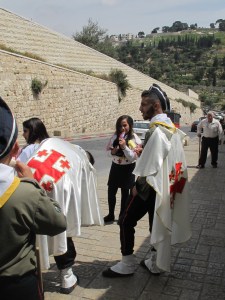
Another interesting group I saw today was Arab Catholic Scouts. I would never have guessed that combination. This is their outfits which they wore proudly.

We woke this morning to church bells ringing. It’s probably not polite, but I find bells much more melodious than the Muslim call to prayer.

After breakfast we had to wait to meet a taxi driver we need early tomorrow morning. Discuss the price and then shake hands. Now it is considered a taxi booking.

We rushed to then make it in time for church at the Lutheran Church in the Old City of Jerusalem. Got there, huffing and puffing. Have I mentioned before just how steep the hills are? My leg muscles are certainly feeling it! Fortunately the narrow, cobbled streets weren’t busy at that time and we didn’t have to navigate people. And we knew where the church was.

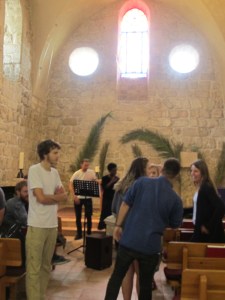
We got there just as they were processing into the church with palm and olive branches. The church was decorated with palm branches. Because it is Palm Sunday.  It’s a small chapel built of stone. The church was very crowded. I sat next to a very helpful young man. A Mennonite from Kansas who is volunteering in Israel for a year, working with Palestinian and other refugees.

We really enjoyed the church service, focusing on the narrative of what happened to Jesus in Easter week. The service was simple and there was great congregational participation to make it very moving and meaningful.

On the way back we stopped at an Armenian cafe for drinks. Next door at the Armenian church they were just finishing their church service as we slipped in. On the steps of the church these children were displaying their special Palm Sunday treasures. Beautifully and skilfully braided palm branches to hold flowers and Easter eggs.

There’s a big Palm Sunday procession through the streets of Old Jerusalem this afternoon with hundreds expected. It has a vague starting time. This is the Middle East who have different ways of doing things. We saw lots of smaller Palm Sunday processions in groups as we walked back this morning from church. Walking the Via Delarosa with their palm branches and singing or praying together.

We’re having a restful afternoon. Tomorrow is a long day. We’re leaving for Petra in Jordan. We are both saying that Petra had better be spectacular! Because the tour that we booked on (with Israel Tourism) has frequently changed the dates, times, transports, costs. It has become a real juggling act. Even yesterday they were making changes.  And every time there’s a change, the cost goes up!

Now we have to catch a taxi from here at 4 o’clock in the morning to drive to Tel Aviv – over an hour’s drive . To catch a small plane to the Red Sea. To catch our transport into  Jordan and then drive to Petra. Hope our eyes are still awake by then! I’m sure it will all work fine. And that it will be worth it. Because Life often turns into an Adventure!

Overload.

As an avid people-watcher, one of the things I’m enjoying about this hotel is that there is wifi only in the huge lobby area of this hotel with lots of comfy armchairs. And as we’re all now connected to our phones and computers like placenta cords, it’s a great place to do my people-watching. When we first arrived here earlier in the week, there were hardly any other guests.

But yesterday was a huge influx. Lots of Jewish families. That surprised me as this hotel is in the Muslim part of Jerusalem. They had their Sabbath meal last night in a separate dining room to the rest of us Christians, Muslims and anyone else. Lots of singing during their Sabbath meal. I would have loved to have gate-crashed it, but I do recognise some boundaries!

Lots of people from other cultures booked in too. Lots of different, both colourful and plain dress, lots of children who all stay up late, lots of different languages. There’s a young man dressed in white with a Jewish skull cap with a gun in a holster on his hip who’s been very busy praying in the lobby. By the way, I would love to know how really bald Jewish men keep their skull caps on!

This morning I was feeling weary. Not physically weary. But on sensory overload. So we’ve had a shorter day. I’ve found over the years, I need recharge time regularly.

It’s also the Jewish Sabbath today so not a lot of Jewish attractions open anyway. We walked down the steep hill into the Old City again this morning. I’d heard about a walk you could do along the city wall ramparts.


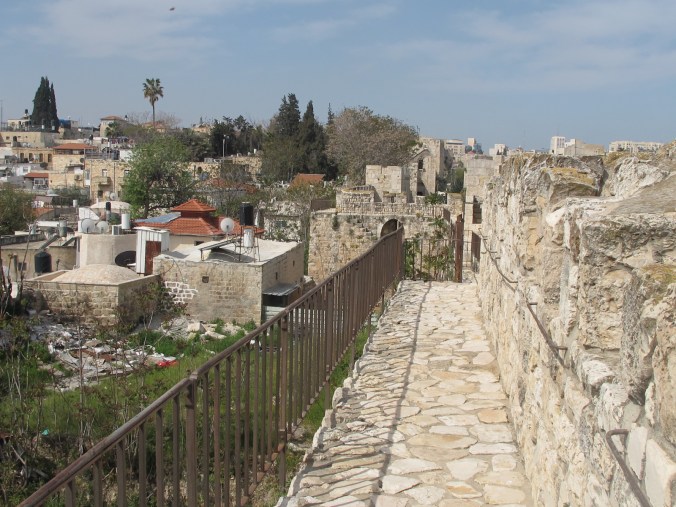
We found a sign but no way to get onto it. Until I found a gap in the metal fence and squeezed through. Philip wouldn’t follow. He thought we’d get thrown out of the Old City if we were discovered. So I followed the narrow path along the city wall as far as I could. Until there was a locked gate I couldn’t get past. There wasn’t much of interest to see really. Over the city wall was just a busy street with cars whizzing and honking. The side I was walking on was just overlooking Muslim backyards and children’s play areas. But no-one much about. So I had to turn round and go back again. But we found out later there is another proper tourist wall ramparts walk that you pay for and it’s probably more interesting. But at least I could say I’ve done it.

IMG_1625

We walked through noisy, crowded and busy bazaars, selling all sorts of food and tourist junk. None of which we bought.

IMG_1633

Then we found on the map a reference to Zedekiah’s cave. That sounded intriguing. So, with a bit of help, because navigating in the Old City can sometimes be a challenge, we found it.

IMG_1636

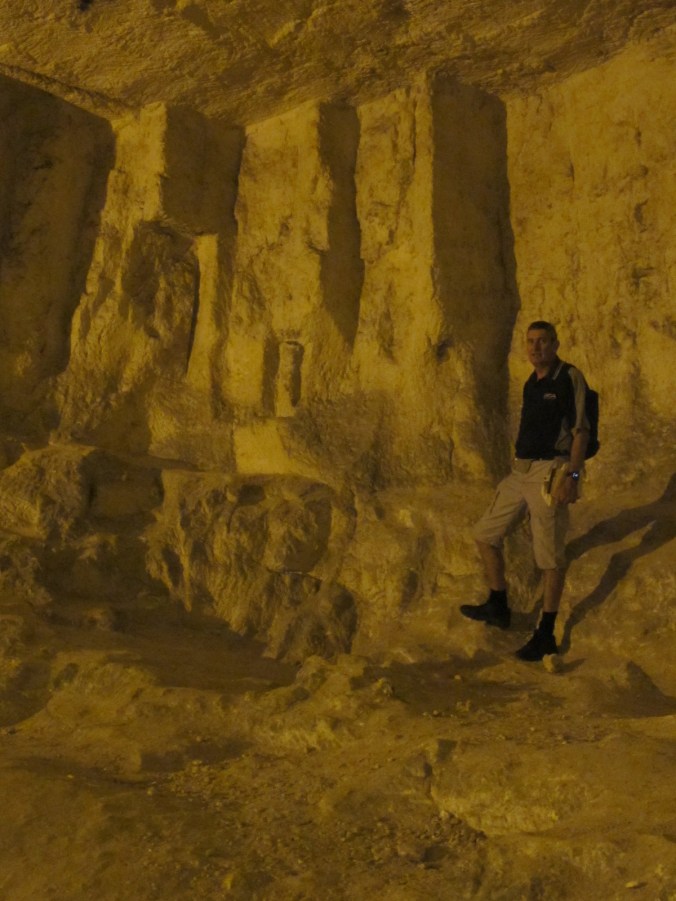
After paying a small entrance fee (made even smaller because they allowed for Australian seniors which we are), we found ourselves in a dimly lit, downward sloping huge, huge cavern. And quiet. Blissfully calm. We were the only ones there and all that could be heard was the slow drip of water as it seeped and dropped from the roof to the floor of the cave. It reminded me of Lord of the Rings or Hobbit landscapes when they’re underground. It runs under the Old City for 230 metres and it’s full height can’t really be seen because of landfills. The stonemasons left huge rock pillars to shore up the ceilings. Right at the very end you can see where they’ve quarried the huge blocks of stone. We marvelled at the sheer craftsmanship that it took to quarry the straight cuts in the huge blocks of stone.

IMG_1642

There’s lots of oral tales of this quarry being used for Solomon’s temple. And it might have been. The evidence shows that it was used for Herod’s Temple – the temple that was there when Jesus walked this earth. We really enjoyed exploring it. Fascinating and quiet!

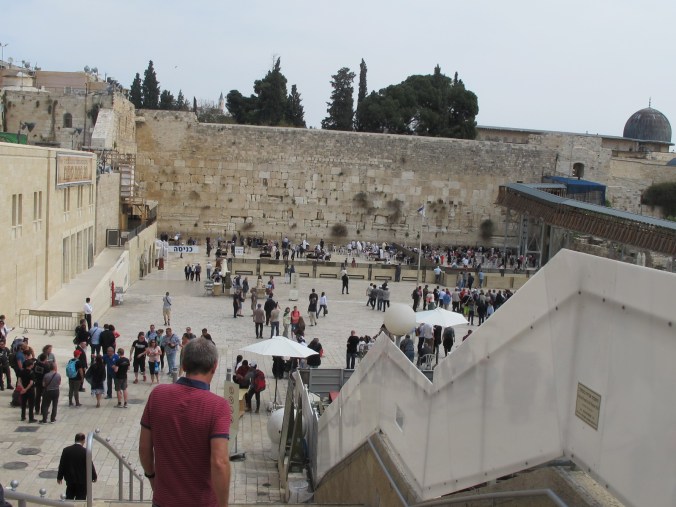
While navigating our way back to the hotel, we found ourselves unexpectedly at the Western Wall. A big open space where Jews come to pray at the Western Wall. A very moving sight. You can feel their great desire and spiritual longing.

IMG_1648

One of my thoughts is that it’s the Christian Arabs who seem to have it hardest in this divided land. Both the Jews and the Muslims have other people and countries behind them. But there’s no-one for the Christian Arabs. Not that I can see anyway.

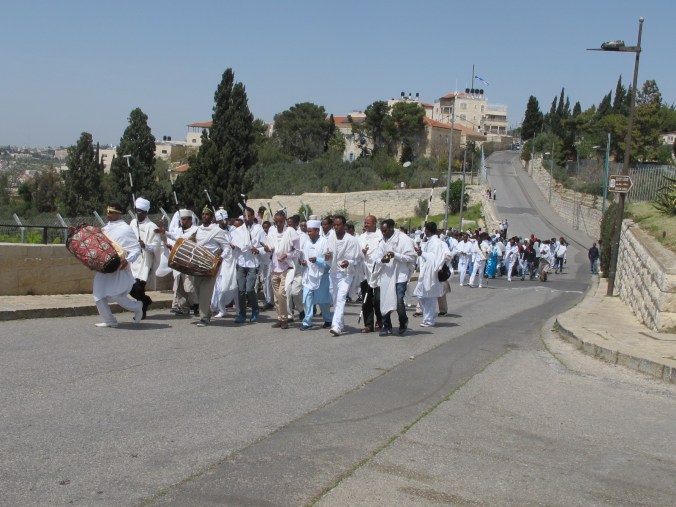
Walking back up the very steep narrow Mount of Olives Road, we came across hundreds of Africans, mainly dressed in white. Some with blue crosses on their long white tunics. Others with green sashes and pictures of Mary with an infant Jesus on their chests. Some with cloth crowns on their heads. Singing and banging drums. Some singing into microphones with other people hauling big loudspeakers on their shoulders as they walked along. We got caught in a big crowd of them on the tight, narrow road. They are from Eritrea. Maybe they’re Eritrean Orthodox Christians. I wouldn’t be surprised if they were a group of a thousand there.  They certainly know how to celebrate!

IMG_1660


Diverted Ways.

Long, long ago – when I was a teenager – my Grandma Lithgow handed on to me an embroidered white handkerchief. It had been sent to her by her favourite brother Roy who had posted it to her from Egypt when he was stationed there in 1917 during World War 1 before he went to Beersheba. Roy had bought it from an Armenian woman who was trying to survive and feed her family. They’d escaped the genocide perpetuated on the Armenians by the Turks (from 1915 to 1917) and were in desperate straits. I’ve never forgotten the story. I still have the handkerchief and will pass it on to Rosie.

The Old City of Jerusalem encircled by walls is divided into quarters – the Armenian, the Christian, the Jewish and the Arabic. I wanted to explore the Armenian Quarter today.

We walked down the steep, narrow road from Mount of Olives where we’re staying, down the Kidron Valley and up to Jerusalem. But instead of walking through, we walked round the outer walls to the far side where is the Armenian Quarter.

But just before we got to Zion Gate which is the entrance to the Armenian Quarter, we were diverted by a big sign saying “The Jerusalem Archaeological Park.” A wonderful diversion. Now I’m in information overload. Important things that I photographed I have now forgotten the details by the time we got back to our hotel!

IMG_1613

Part of Jerusalem Archaeological Park

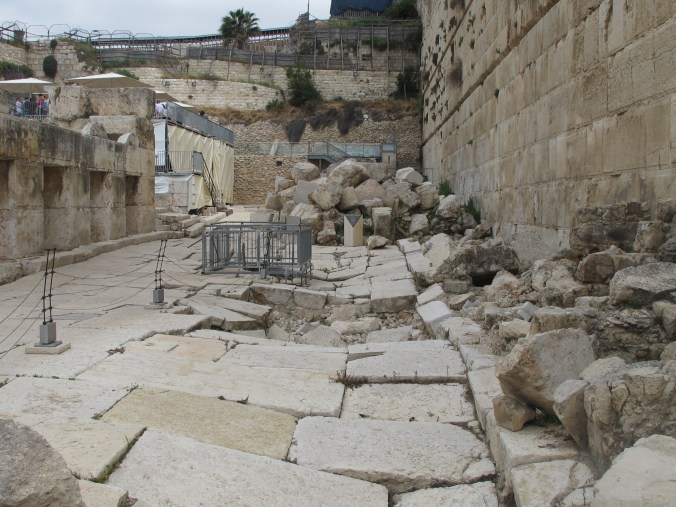
It was a huge area below the big walls of Jerusalem.

IMG_1606

This is a street from Herod’s and Jesus’s time. The arches on the left led into shops needed for pilgrims at the Temple. The hole in the pavement was made by rocks heaved down from the top of the walls of Jerusalem when Rome sacked it in 70AD. Behind it you can see a huge pile of rubble that was heaved over. 

There were excavated coins from the reign of Solomon. Uncovered steps and stonework that go back to what is called the Second Temple period. This is the time of Herod the Great and Jesus.

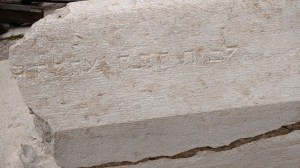
This huge stone was hurled 40 metres from the top of the corner of Temple Mount by the Romans who destroyed the Temple. On this stone the trumpeter proclaimed the coming Sabbath. The inscription reads “to the Trumpeting Place to …” The niche at the bottom of the stone is the place where the trumpeter stood.

But also the Roman time, the Byzantine era, the Muslim eras, the Crusades. There were exhibitions that vividly brought to life the Second Temple times. And what the Temple and the precincts around it would have been like in the times of Jesus.

IMG_1612

Stone storage urns 

Jerusalem has for millenia been a place of pilgrimage. One of my preconceptions that Jerusalem would be over-run by American tourists. But it’s mainly European and Asian tourists and pilgrims here. Of all faiths, Christian, Jewish and Muslim.

IMG_1608

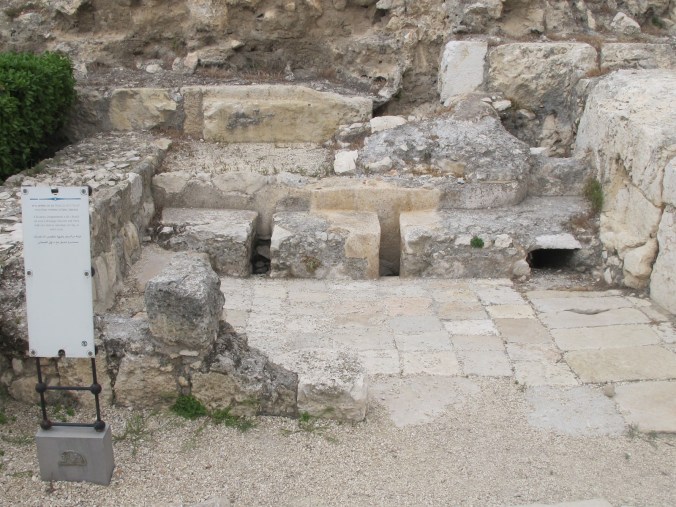
Toilets that dropped down to drainage channels

We did wander around the Armenian Quarter but there wasn’t much to see. We got to peep into a private housing courtyard, courtesy of a Dutch gentleman who was standing nearby. His daughter lectures at the nearby Orthodox Armenian seminary.

Another fun diversion happened when we poked our noses into a tiny little Greek church. (There are churches everywhere.) As we were going back out through the courtyard, a stooped, old lady beckoned us over and by mime was asking us to help her unlock her door. She might have been a Greek Orthodox nun. The key was dipped into oil and Philip wrestled with it. When he opened it, she was so grateful!

Wandering around the twisting cobbled streets we came across the huge Church of the Sepulchre where tradition has it that lots of things happened there to Jesus – his circumcision, his presentation, his burial and resurrection. A huge, high domed church with people crowded in everywhere. So many spiritually thirsty pilgrims, standing in lines to see, pray and touch special relics. It was very noisy.


Further down we went in to the Church of the Redeemer – a fairly recent church built in 1898 for German, Arabic and English Protestants, on the site of previous ruined churches. But they’ve done a lot of archaeological excavations underneath the church so tourists can access it. A deep shaft, 14 metres that you looked down and at the very bottom was the quarry used for getting stones for Herod’s Temple.

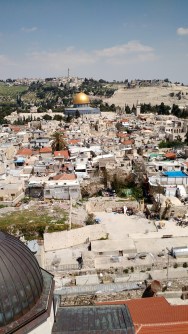
And I could climb to the top of their church tower. A thousand (or so it seemed) narrow, windey steps that just kept twisting round and round and up and up. At the top the most wonderful 360 view all over the Old City and the mountains all around Jerusalem. Peering down into people’s courtyards and some of the streets.

View from the top. Our hotel is on the top of the hill on the right.

No matter which way you turn or go in the Old City there are diversions to see. Exploring the fascinating, difficult and troubling times of this city and its people down through the millenia. Not just down through the centuries, but down through the millenia!

A wonderful day exploring lots of diverting ways.

Old olive tree