That’s probably not be spelt correctly. But I heard it a lot today. My interpretation is that it means “Come along now” with slight undertones of “hurry” too.
A 3.30 am start this morning. For a taxi ride through quiet Israeli streets to the small airport north of Tel Aviv. To be dropped at the gates to wait for the airport to open at 5.30am. A very, very thorough security and baggage check. Is it normally like this, or have they stepped it up because of what happened in Egypt on Palm Sunday?
Then a 30 minute flight on a small plane south to Eilat, a town on the Red Sea. But we were hardly up in the air and then we were coming down again. A bit like getting a plane from Perth to Dunsborough.
To be met by others on the tour and the tour rep who was very good at expediating the border crossing into Jordan. More paperwork, more money, more security checks, more bag checks.
What tickles my funny bone is that Israel isn’t recognised by many Middle Eastern countries. So for them all to co-exist and make it work – especially in the tourist industry – Israel doesn’t stamp your passport. Your visa, your entry permit and your exit permit are all on little slips of paper so there is no record that you’ve been to Israel in your passport. Then when you go to places like Jordan you take those little slips of paper and put them in your pocket and they happily stamp your passport with their Jordan stamps because you haven’t really been in Israel! Except that you’ve just walked over the border, down the road between high wire fences out of Israel and there is nowhere else you could have come from!
It’s a bit like buildings without a thirteenth floor. You can call them 12A or fourteen. But no matter what you call it, it’s still the thirteenth floor.
Then off we went in a coach on a four lane highway for about 1 and half hours through the desert to Petra. The overwhelming colour is brown. High, jagged, steep and very very stoney mountains everywhere. The mountains of Edom. Philip said it reminded him a lot of the Pilbara region of W.A.

And every now and then you’d see a black Bedouin tent in the middle of the stones. Small flocks of sheep and goats always watched by someone. Often they’re just sitting there. Occasionally walking around with a staff. It looks such a Biblical scene. And I wondered why did Jesus call himself a good Shepherd, and not a good Goat-herder? And why are we his sheep and not his goats?
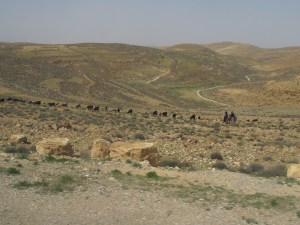
Sometimes there’d be a faint green fuzz on the stoney ground and mountainsides. The Bedouin plough these stoney grounds and plant wheat and barley – not to be harvested – but as feed for their animals.
As we got closer to Petra, the mountains became not quite as jagged, a bit more rounded. Petra is big tourism business. It’s a town of 25,000 people. A lot of the Bedouins are starting to settle into houses now. There’s a huge bus park and entrance and people milling around everywhere.
It’s an hour downward sloping walk through high gorge walls on either side of you. As high as Katherine Gorge walls. And even though everyone has seen the photos of Petra’s most famous building, called the Treasury, it’s still a “wow” moment when you first glimpse it through the narrow chasm.

Petra was a huge trading city and area for centuries and the Naboteans were a powerful trading civilisation till the trading routes changed. And all those carvings and buildings, including the Treasury are really mausoleums. The Nabotean buildings and towns were destroyed by a couple of earthquakes centuries ago. The mausoleums got looted centuries ago and then the empty holes and caves did become dwellings for the indigenous people of the area for a long time.
There’s a huge amphitheatre that seated 6000 people, carved into the stone.

That huge “Treasury” building is amazing! When we first glimpsed it, the tour guide played the Indiana Jones theme music softly on his phone! To help the atmosphere I think! But it’s very impressive. “They” estimated that it took 100 men working every day for 20 years to carve it. It is massive. They did the carvings from the top down, using scaffolding and ropes. How important it seemed to be remembered and revered after their death.

We spent about 4 hours there. There are horses, donkeys, camels and horse-drawn carts careering up and down the roadway. Lots of hawkers trying to sell you tourist stuff.
Parts of the roadway still have the original boulder cobblestones. There’s drainage channels carved into the sides of the road. A very clever and competent civilisation. And now it’s all gone. With not a whole lot to remember it by.

After a late lunch in a cafe back into the town of Petra, it was back on the bus again. But before we got back to Eilat, Philip and I got off that bus and we’ve made a tourist detour.
To Wadi Rum. A Bedouin tourist camp. Driven here far off the highway by a Bedouin in a four-wheel ute. It’s a big stoned wall enclosure with lots of date palms and little tents set up. Philip and I have got a little tent with two very small beds in it. But there’s sewerage toilets and running water. A big open area where we’ve just had a buffet Jordanian dinner. About 30 or so tourists here.
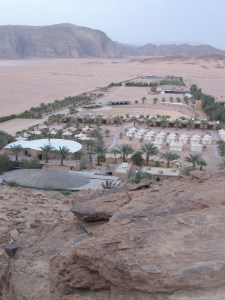
Wadi Rum, taken from the top of a big hill we climbed
But I was very surprised to get the internet here. Let’s see if it’s strong enough to send a blog. I laughed when we got here and asked “Did the Bedouins have electricity in their tents?” But then I discovered there’s wifi in the eating area! Amazing!
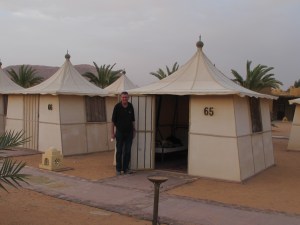
And soon we’ll be ready for bed. We’re both quite weary after such a long and fun day. So I don’t think it will matter what our mattresses are like. And I’m trying to remember the last time I had to take a trek to go to the toilet in the middle of the night!
 Standing on a hill