Long, long ago – when I was a teenager – my Grandma Lithgow handed on to me an embroidered white handkerchief. It had been sent to her by her favourite brother Roy who had posted it to her from Egypt when he was stationed there in 1917 during World War 1 before he went to Beersheba. Roy had bought it from an Armenian woman who was trying to survive and feed her family. They’d escaped the genocide perpetuated on the Armenians by the Turks (from 1915 to 1917) and were in desperate straits. I’ve never forgotten the story. I still have the handkerchief and will pass it on to Rosie.
The Old City of Jerusalem encircled by walls is divided into quarters – the Armenian, the Christian, the Jewish and the Arabic. I wanted to explore the Armenian Quarter today.
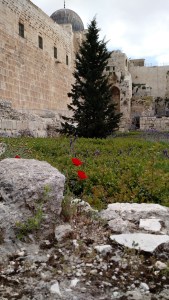
We walked down the steep, narrow road from Mount of Olives where we’re staying, down the Kidron Valley and up to Jerusalem. But instead of walking through, we walked round the outer walls to the far side where is the Armenian Quarter.
But just before we got to Zion Gate which is the entrance to the Armenian Quarter, we were diverted by a big sign saying “The Jerusalem Archaeological Park.” A wonderful diversion. Now I’m in information overload. Important things that I photographed I have now forgotten the details by the time we got back to our hotel!

Part of Jerusalem Archaeological Park
It was a huge area below the big walls of Jerusalem.
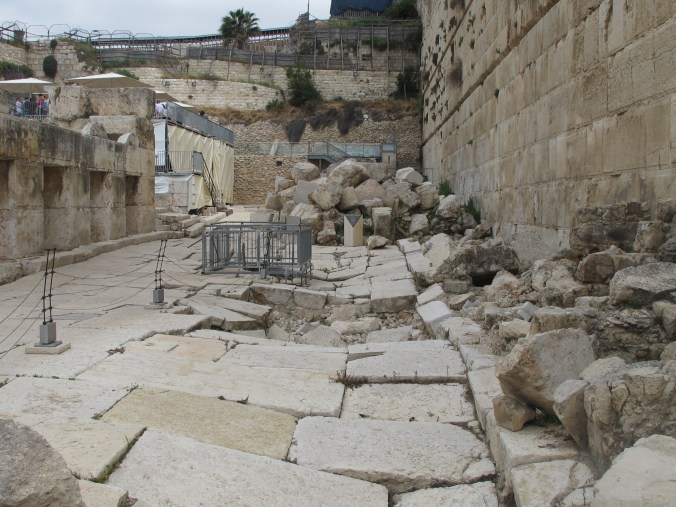
This is a street from Herod’s and Jesus’s time. The arches on the left led into shops needed for pilgrims at the Temple. The hole in the pavement was made by rocks heaved down from the top of the walls of Jerusalem when Rome sacked it in 70AD. Behind it you can see a huge pile of rubble that was heaved over.
There were excavated coins from the reign of Solomon. Uncovered steps and stonework that go back to what is called the Second Temple period. This is the time of Herod the Great and Jesus.
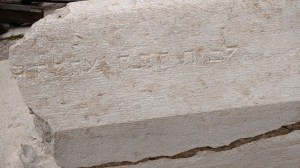
This huge stone was hurled 40 metres from the top of the corner of Temple Mount by the Romans who destroyed the Temple. On this stone the trumpeter proclaimed the coming Sabbath. The inscription reads “to the Trumpeting Place to …” The niche at the bottom of the stone is the place where the trumpeter stood.
But also the Roman time, the Byzantine era, the Muslim eras, the Crusades. There were exhibitions that vividly brought to life the Second Temple times. And what the Temple and the precincts around it would have been like in the times of Jesus.

Stone storage urns
Jerusalem has for millenia been a place of pilgrimage. One of my preconceptions that Jerusalem would be over-run by American tourists. But it’s mainly European and Asian tourists and pilgrims here. Of all faiths, Christian, Jewish and Muslim.
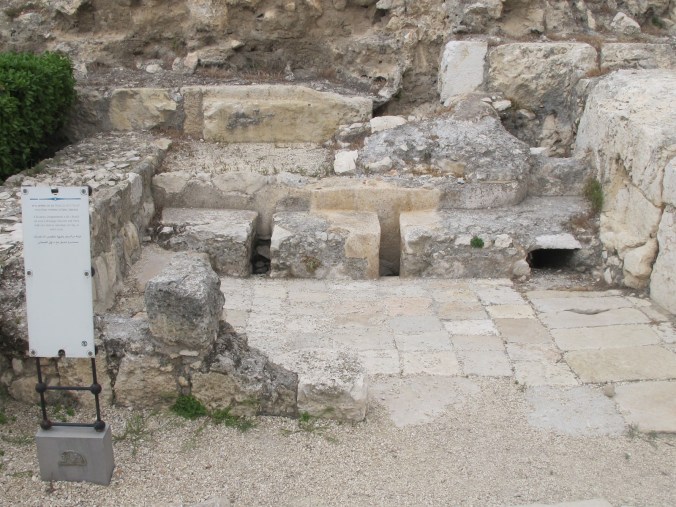
Toilets that dropped down to drainage channels
We did wander around the Armenian Quarter but there wasn’t much to see. We got to peep into a private housing courtyard, courtesy of a Dutch gentleman who was standing nearby. His daughter lectures at the nearby Orthodox Armenian seminary.
Another fun diversion happened when we poked our noses into a tiny little Greek church. (There are churches everywhere.) As we were going back out through the courtyard, a stooped, old lady beckoned us over and by mime was asking us to help her unlock her door. She might have been a Greek Orthodox nun. The key was dipped into oil and Philip wrestled with it. When he opened it, she was so grateful!

Wandering around the twisting cobbled streets we came across the huge Church of the Sepulchre where tradition has it that lots of things happened there to Jesus – his circumcision, his presentation, his burial and resurrection. A huge, high domed church with people crowded in everywhere. So many spiritually thirsty pilgrims, standing in lines to see, pray and touch special relics. It was very noisy.

Further down we went in to the Church of the Redeemer – a fairly recent church built in 1898 for German, Arabic and English Protestants, on the site of previous ruined churches. But they’ve done a lot of archaeological excavations underneath the church so tourists can access it. A deep shaft, 14 metres that you looked down and at the very bottom was the quarry used for getting stones for Herod’s Temple.
And I could climb to the top of their church tower. A thousand (or so it seemed) narrow, windey steps that just kept twisting round and round and up and up. At the top the most wonderful 360 view all over the Old City and the mountains all around Jerusalem. Peering down into people’s courtyards and some of the streets.
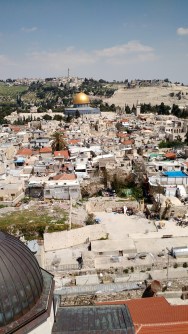
View from the top. Our hotel is on the top of the hill on the right.
No matter which way you turn or go in the Old City there are diversions to see. Exploring the fascinating, difficult and troubling times of this city and its people down through the millenia. Not just down through the centuries, but down through the millenia!
A wonderful day exploring lots of diverting ways.

Old olive tree
 Standing on a hill